 YR Sports Lab
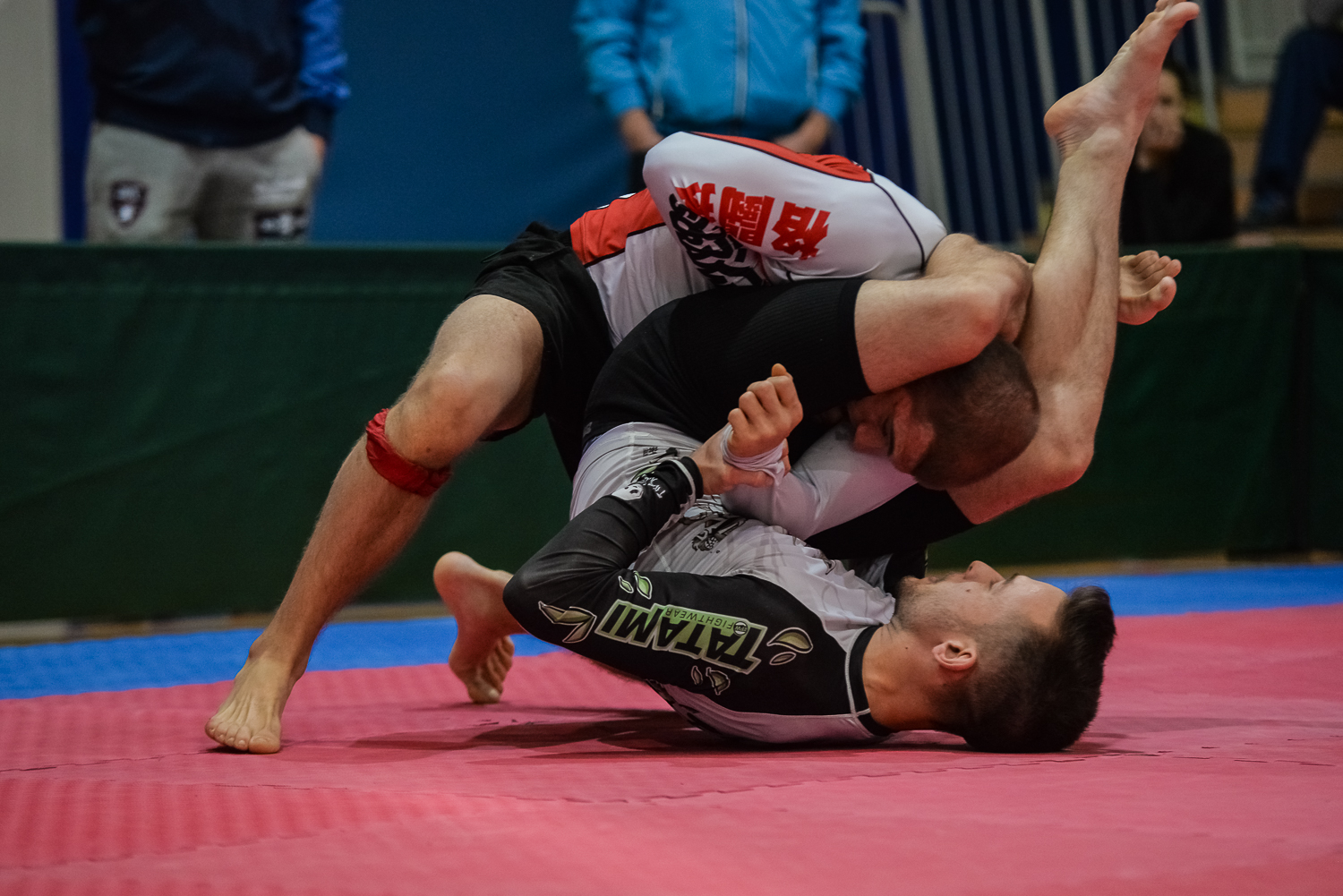
The triangle choke (sankaku-jime) is the most iconic bottom-position attack in the history of BJJ. Match records from IBJJF Worlds 2019 under GI rules show that once the triangle is entered, its overall finish rate reaches 62% (28/45), second only to the rear naked choke and the second most efficient submission in the gi. Yet the same technique under No-Gi rules sees its success rate collapse to roughly 28% (7/25). Gi friction and sweat-slick skin are enough to turn one technique from a reliable weapon into a coin flip. This article works from the fluid mechanics of carotid occlusion (roughly 10 to 20 seconds to unconsciousness, carotid pressure around 4 kPa), the physics proof behind the 45° rotation, and the finishing windows of 5 triangle variations, through to PubMed research on the long-term effect of repeated chokes on carotid intima-media thickness (CIMT), breaking this seemingly simple "legs around the head" down to its mechanical foundations.
1. Triangle anatomy: you are choking the carotid, not the airway
To understand why the triangle can render an opponent unconscious in roughly 10 to 20 seconds, you first have to separate the "blood choke" from the "air choke". The triangle is a pure blood choke: its target is not compressing the trachea to suffocate the opponent but simultaneously occluding both common carotid arteries and cutting off blood flow to the brain. The airway is not the target at all.
Anatomically the carotid artery sits medial to the sternocleidomastoid (SCM) and lateral to the trachea, at an average depth of about 1.5 cm, with a pulse pressure of 70–110 mmHg (roughly 9–15 kPa). The "triangle" is closed by three structures: the attacker's shin (pressing the right side of the opponent's neck), the attacker's inner thigh (pressing the back of the neck and shoulder), and the opponent's own shoulder plus the trapped arm (pressing the left side of the neck). All three converge at once, turning the opponent's own shoulder into the clamp that compresses the far-side carotid. That is exactly why the triangle is called a "self-choke": the opponent's anatomy does half the work for you.
Before it branches in the neck the common carotid is about 6–8 mm in diameter with a 0.6 mm wall. The external pressure needed to occlude it is only about 4 kPa (30 mmHg), far below the pressure of body weight or a joint squeeze. The difficulty lies in precise placement, not raw strength.
Internal jugular pressure is only around 1 kPa (8 mmHg), so its occlusion threshold is even lower. As the triangle tightens, what the opponent notices first is a flushed face and throbbing temples (venous congestion), and only afterwards does vision darken (arterial ischemia). Red to purple to pale marks the sequence from venous to arterial occlusion.
The trachea sits on the anterior midline of the neck, supported by C-shaped cartilage. A correct triangle should never press on the trachea. If the opponent reports "I cannot breathe, my throat is being crushed" rather than "my head is going fuzzy", your pressure is too far forward, which usually means your leg position is wrong and needs adjusting.
The carotid sinus is extremely pressure sensitive, and a tightening triangle can trigger the baroreceptor reflex (BCR), causing a sharp drop in heart rate and blood pressure. This is part of why triangle-induced unconsciousness can arrive faster than expected: besides ischemia, the vagus nerve also contributes to the faint.
📊 PubMed evidence: the hemodynamics of chokes
PubMed 2192520 (Denk, Helmer & Missliwetz, 1990, Carotid and vertebral artery circulation in forearm choke holds in Doppler sonography): Doppler ultrasound was used to measure carotid flow directly under a choke, and flow could be partially reduced through to complete arrest depending on the direction of the applied force. This study is the foundation for all later "choke and blood flow" research.
PubMed 32271638 (Stellpflug et al., 2020, The safety of sportive chokes: a cross-sectional survey-based study): analysing post-choke responses in BJJ and judo practitioners, the vast majority of choked-out cases regained consciousness within 5–15 seconds with no long-term neurological deficit. Even so, in the survey 2 of 4,307 respondents (0.05%) reported persistent symptoms from a choke, a reminder that chokes are not entirely harmless.
PubMed 40202022 (2025, vascular neck restraint MMA): integrating several studies, it concludes that the main pathological mechanism of choke-induced unconsciousness is cerebral hypoxia caused by falling cerebral perfusion pressure, driven by simultaneous jugular and carotid compression rather than airway obstruction.
PubMed 38857060 (Stellpflug et al., 2025, Sportive chokes CIMT study): comparing frequently choked jiu-jitsu practitioners with controls on carotid intima-media thickness (CIMT) and brain injury biomarkers, the study found no significant difference in CIMT (grapplers 0.55 mm vs controls 0.57 mm, p=0.498) and no significant difference in four brain injury markers either; this is a preliminary cross-sectional study, and long-term cumulative effects still require larger samples and longitudinal follow-up.
2. IBJJF and ADCC match data: why GI and No-Gi differ by a factor of two
Triangle choke data in BJJ competition shows a stark "rule effect": the presence or absence of a gi is enough to shift the same technique's success rate by more than 30 percentage points. This is not a question of technical quality, it is physics and biomechanics. The table below combines triangle choke statistics from three competition systems: IBJJF Worlds 2019, IBJJF Europeans 2024–2025 and ADCC 2022–2024.
| Ruleset | Triangle finish rate | Share of all chokes | Main variations | 2026 trend |
|---|---|---|---|---|
| IBJJF Worlds GI black belt (2019) | 62% (28/45) | 9.2% | Standard, rear triangle | Flat |
| IBJJF Europeans GI black belt (2025) | 58% | 7.4% | Standard, mounted | Declining (lapel chokes rising) |
| IBJJF Worlds No-Gi (2025) | 32% | 5.1% | Standard, reverse | Flat |
| ADCC 2022 men's black belt | 26% | 4.3% | Standard, side triangle | Declining (displaced by leg locks) |
| Gym sparring (BJJ Globetrotter survey) | 41% | 11.8% | Mostly standard triangle | Popular at white to purple belt |
Key observation one: GI and No-Gi differ by a factor of two. The gi collar offers extra grips and leverage (the attacker can pull the collar to drive the head down and use the sleeve to trap the arm), which sharply reduces the chance of the opponent sliding out. In No-Gi, sweat makes the opponent's thigh, arm and head all easier to slip free, and being stuck at "80% locked" is the norm.
Key observation two: the triangle's share at elite level is falling. Both timelines, IBJJF 2019 to 2025 and ADCC 2017 to 2024, show a gradual year-on-year decline in the triangle's share of finishes in elite men's divisions, displaced by the No-Gi leg lock system and by the lapel chokes that grow out of the mounted triangle in the gi. Yet at white, blue and purple belt the triangle remains one of the most popular attacks, because the strategic value of counterattacking from the bottom is enormous at lower belts.
3. The 45° rule: why the finishing angle decides everything
"The triangle is won with angle, not leg strength" is a line shared by Roger Gracie, Marcelo Garcia and John Danaher. In physics terms it means: when you face the opponent squarely (0°), the pressure component your leg triangle applies to the carotid is far below its maximum; rotate to 45–90° and that component peaks.
Mathematically this is vector decomposition: with the same leg force (say 200 N), when the direction of force sits at 0° relative to the opponent's neck axis (square on), the effective component along the carotid is only cos(90°) ≈ 0, so almost all of it is wasted pushing the opponent forward. Rotate to 45° and the effective component rises to cos(45°) ≈ 0.71; at 90°, nearly 100% of the force converts into carotid occlusion pressure. That is the physics proof behind "same leg strength, double the finish rate after rotating 45°".
・The opponent's head is buried on your navel, your legs are squeezing hard, and his color is normal. That is close to a diagnosis: you are still at 0°, and nearly all your force is pushing forward instead of compressing the carotid.
・Fix: pull your right heel toward your left shoulder, lean the left shoulder back and left, and rotate the hips 45° as a unit. That move drives the opponent's right shoulder into the far-side carotid, and the triangle switches instantly from "stuck" to "counting down roughly 10 to 20 seconds".
・Elite coaching consensus: turn, do not wrench; rotate, do not squeeze. There is only so much extra force you can add to a triangle, and angle adjustment is the real source of finishing power.
4. Five triangle variations: entry windows and scoring efficiency
The triangle is not one technique, it is a family. The five below appear most often in IBJJF and ADCC competition, and each has a different entry position, target carotid direction and optimal finishing angle.
Entered from closed guard or open guard with one of the opponent's arms pulled in and the other left outside. It is the version taught first in BJJ and has the largest share in competition. Optimal angle: rotate to 45–60° to drive the opponent's right shoulder into the far-side carotid.
Attacked from the back or from on top of the turtle, with one arm hooked into a rear triangle and the carotid attacked from behind. Hard to enter but lethal, and it cannot be escaped by standing up and dumping the attacker. A Marcelo Garcia signature, common in ADCC and IBJJF No-Gi.
Entered from side control or north-south, with the opponent trapped from the side and the legs wrapping horizontally. In competition it is often paired with the armbar: threaten the armbar to draw the defense, then rotate into the side triangle to finish. It is a common attacking path in both gi and No-Gi.
Entered by jumping from standing, throwing one leg over the neck while the other hooks back to close the triangle. Spectacular but with the lowest competition success rate (< 8%). It relies on the opponent's head position and gripping habits, and if he simply keeps his head up you get slammed. Mostly seen in demonstrations and in "roll the dice" moments in ADCC men's divisions.
Entered by rotating from high mount, with the attacker entirely on top and the legs crossed behind the opponent's neck. It loads the opponent's spine far more than the other variations and is widely seen as the version with the strongest physical control in the triangle family. Because of the distance and angle constraints, though, its overall efficiency still trails the standard triangle.
Whatever the variation, the determinant of finishing power is always "rotate to 45–90°, then apply force", not "squeeze the legs harder". This is also how coaches judge technical maturity: a purple belt who finds the angle finishes faster than a black belt who just squeezes.
5. Defense and escape: reading the 4 windows
Unlike the heel hook, the triangle offers a full "rising pressure to altered consciousness" feedback path, giving the defender several decision points. The table below follows the 4-window classification used in Lachlan Giles and Saulo Ribeiro instructionals:
| Phase | Situation | Escape action | If you stay |
|---|---|---|---|
| P1 setup | Opponent pulls your head and one arm toward his hip | Posture up immediately, separate the hands, push the hips | You enter the next phase |
| P2 lock | Opponent has crossed the legs to close the triangle but has not adjusted the angle | Drive the trapped arm across his body, step around to the same side | Opponent starts hunting for the angle |
| P3 angle | Opponent has rotated to 45° and is tightening | Grip the knee, use the forearm to relieve pressure, attempt a stack pass or knee pin | Altered consciousness within 10 seconds |
| P4 ischemia | Vision darkening, throbbing temples, dizziness | Tap immediately. Fighting through equals unconsciousness or carotid dissection | Loss of consciousness in roughly 10 to 20 seconds |
・Getting choked out is not a nap. PubMed 29152471 reports internal carotid artery dissection (ICAD) in BJJ practitioners, with TIA-like symptoms and even focal cerebral infarction.
・The long-term impact of repeated chokeouts remains unsettled: the preliminary cross-sectional study in PubMed 38857060 found no significant CIMT or brain-injury-marker abnormality in grapplers (p=0.498), but the sample was limited and cumulative risk cannot be ruled out.
・The price of riding out a triangle can be a TIA, a stroke or permanent neurological injury, a risk wildly out of proportion to "losing one more training round".
The consensus among elite competitors: once a choke reaches the dizzy stage, tap. No technique in training is worth trading a carotid dissection for.
6. Offensive strategy: triangle training priorities for white to purple belts
🎯 Five triangle principles you can apply immediately
1. Position first, finish second. The classic white belt error is squeezing the moment the legs cross. The correct order is: dominant grip (control his posture) → trap one arm in, one arm out → cross the legs → rotate to 45° → then apply force. Until the first four steps are done, keep leg effort under 30%. This is the coaching phrase "lock the trap first, then close the door".
2. A lowered head is an invitation. When the opponent drops his head inside your closed guard and posts both hands on your chest, his posture is actively building the entry space for a triangle. That is why the first thing high-level coaches teach in closed guard is breaking posture, so that he lowers his head himself.
3. Angle matters five times more than force. If you find yourself thinking "I am squeezing hard but he is fine", stop adding leg force and go hunting for the angle. Pull the right heel toward the left shoulder and rotate the torso left. Same force, different direction, and you go from "stuck" to "finished in 9 seconds".
4. Use the "lock without squeezing" clock strategy. If you enter the triangle in competition without a clear finish, holding the opponent there, burning time and accumulating his fatigue is already a decent outcome. His posture inside the triangle is extremely taxing, and after 5–10 seconds he will make a mistake that opens an attack.
5. The triangle → armbar → rear triangle attack chain. Elite competitors do not rely on a single technique. Threaten the triangle to draw a defense → switch to the armbar → he defends the armbar → switch to the rear triangle. Roger Gracie, Marcelo Garcia and Gordon Ryan are all masters of this chain. For white through purple belts, the transitions between these three are the highest-ROI thing to drill.
7. Strength program: the muscles behind the triangle
The triangle looks like "legs squeezing a neck", but its real finishing power comes from isometric hip flexion, sustained adductor tension and explosive trunk rotation. The table below lists training recommendations aimed at triangle finishing strength:
| Exercise | Load | Sets | Primary target |
|---|---|---|---|
| Pallof press (standing anti-rotation) | Band, moderate | 12 reps × 3 per side | Anti-rotation trunk stability, the core base for rotating to 45° |
| Copenhagen adduction | Bodyweight | 8 reps × 3 per side | Eccentric adductor strength, the key to triangle squeezing power |
| Supine hip flexion with leg raise (V-up) | Bodyweight | 10 reps × 3 | Hip flexor power, needed at the instant the triangle closes |
| Glute bridge with march | Bodyweight | 12 reps × 3 per side | Unilateral glute activation, prevents the hips sagging in the triangle |
| Side plank with rotation | Bodyweight | 30 s × 3 per side | Lateral core stability, supports the rotation to 45° |
| Supine triangle closure against a wall | Wall and mirror | 30 s × 5 | Technical motor patterning, builds angle awareness and closing rhythm |
8. Managing a chokeout and the long-term concerns
Going out cold to a submission is not rare in a BJJ gym, but the vast majority of practitioners underestimate the latent risk. The table below sets out management and monitoring recommendations drawn from the PubMed literature:
Release the triangle immediately, roll the person onto their side, confirm breathing and returning consciousness. The overwhelming majority recover on their own within 5–15 seconds. Once awake, assess: headache, blurred vision, unilateral limb weakness (stroke signs). Any positive finding means immediate medical care.
Monitor for 24 hours after a chokeout: persistent headache ≥ 4 hours, unilateral facial numbness, vision change, severe neck pain. These are early signs of internal carotid artery dissection (ICAD). Cases in PubMed 35934648 show ICAD symptoms may not appear until several days later.
No red flag symptoms → drilling can resume within 24 hours, but avoid being choked, avoid high-intensity conditioning and avoid stack passes. Still symptom-free after a week means a full return to sparring. Red flag symptoms → neurology consult plus CTA or MRA imaging.
Long-term BJJ practitioners should consider a neck ultrasound (CIMT measurement) every 5 years, especially those over 40 or with cardiovascular risk factors. Practitioners with ≥ 10 chokeouts should discuss an individualized risk assessment with a sports cardiologist.
※ The rehabilitation timelines, repetition counts and return thresholds listed here are common clinical experience ranges rather than figures taken from the studies cited in this article. Individual variation is large, so have a physician or physical therapist prescribe your actual plan.
References
1. Koiwai EK. (1987). Deaths allegedly caused by the use of choke holds (shime-waza). J Forensic Sci;32(2):419-432. PubMed 3572335 (a correctly applied choke causes unconsciousness within 10 to 20 seconds; no choke-related fatality has been reported in judo since its founding in 1882)
2. Denk W, Helmer M, Missliwetz J. (1990). Carotid and vertebral artery circulation in forearm choke holds in Doppler sonography. Z Rechtsmed;103(5):369-377. PubMed 2192520 (direct Doppler measurement: lateral neck pressure can obstruct carotid flow up to complete arrest, with the degree depending on the direction of force)
3. Sasaki E, Ikumi A, Sakuyama N, et al. (2022). High-rate settlement and unconsciousness with shime-waza in young judo athletes. J Sci Med Sport;25(11):942-947. PubMed 36167661 (307 of 7,426 bouts, 4.1%, at judo world championships ended by choke; unconsciousness rates were 18.9% in cadets, 14.6% in juniors and 4.3% in seniors. This is currently the only peer-reviewed data on the competition share of chokes)
4. Stellpflug SJ, Schindler BR, Corry JJ, et al. (2020). The safety of sportive chokes: a cross-sectional survey-based study. Phys Sportsmed;48(4):473-479. PubMed 32271638 (of 4,307 respondents, 27.8% had been choked unconscious and 75.7% had come close to fainting, while only 2 people, 0.05%, reported persistent symptoms)
5. Stellpflug SJ, Dalrymple KA, Stone D, et al. (2025). Impact of repeated sportive chokes on carotid intima media thickness and brain injury biomarkers in grappling athletes. Phys Sportsmed;53(1):18-26. PubMed 38857060 (carotid intima-media thickness was 0.55 mm in the grappling group versus 0.57 mm in controls, p=0.498, with no significant difference in four brain injury markers either)
6. Stellpflug SJ, Dummer MF, Martin CD, et al. (2022). Cervical Artery Dissections and Ischemic Strokes Associated with Vascular Neck Compression Techniques. J Emerg Med;63(1):49-57. PubMed 35934648 (10 cases: 5 carotid dissections, 3 vertebral artery dissections and 2 ischemic strokes)
7. International Brazilian Jiu-Jitsu Federation. Championship Results (official results for each event from 1994 to 2026). ibjjf.com/events/results (the source data behind the competition-level statements in this article. The federation publishes only placings and brackets, not aggregated finish rates by technique; accessed August 2026)