 YR Sports Lab

Worm Guard is the most distinctive gi control system Brazilian jiu-jitsu has produced in the past decade, and American competitor Keenan Cornelius invented it by accident in a grip battle he simply could not win. It uses a single lapel to lock an opponent's leg and torso at the same time, replacing grip strength with structural tension, and it reshaped how passing works in the gi. This field guide starts with the invention story, then breaks down the setup steps, typical entry timing, strengths and limits, common passing counters, and where the position stands in today's gi competition, along with its safety considerations.
1. Origins: an invention forced out of a losing grip battle
Keenan Cornelius was born on 25 February 1992 in Hilo, Hawaii, and started jiu-jitsu at 14 (in 2006). He trained under Cassio Werneck and at B.J. Penn's MMA academy, joined Team Lloyd Irvin in 2011, then moved to André Galvão's Atos Jiu-Jitsu headquarters in San Diego in 2013, where Galvão personally promoted him to black belt on 14 September that same year. He left Atos in 2019 to found his own team, Legion American Jiu-Jitsu.
One marker of Keenan's rise came while he was still a purple belt: the "double grand slam" of 2012. In a single year he took gold in both his weight class and the absolute division at the IBJJF World Championship, Pan American Championship, European Open and Brazilian Nationals. According to Graciemag, that made him the only competitor to have achieved it at the time.
Worm Guard itself was born out of a grip battle he kept losing. Around 2011 to 2012, Keenan was drilling with training partner JT Torres, whose grips were so strong that every hold Keenan established was stripped first. So he reached for the one thing still available: his opponent's loose gi lapel. He originally called the position "Marionette Guard", and only later renamed it Worm Guard, a name coined by his coach at the time, André Galvão.
By Keenan's own account in a FloGrappling interview, JT Torres at one point banned him from using the purely stalling version in training, where he hooked the lapel with his feet and never attacked, because it just deadlocked the round. Keenan also deliberately avoided lapel work entirely in his official purple and brown belt matches, keeping the system in the training room to refine it. It was only after joining Atos in 2013, facing new teammates who had never seen the system, that he found it had "suddenly become extremely effective", and he gradually brought it into competition from there.
As Keenan kept showcasing the system through his early black belt years, more and more competitors began studying how to deal with lapel control, and Worm Guard branched into several variations: Reverse De La Worm with the wrap direction flipped, Rear Worm wrapping from behind, and Squid Guard, developed from the foot-on-lapel games of competitors such as Cobrinha and Satoshi Franca. Together they form the modern lapel guard family.
One lapel doing the work of two hands
The key mechanical insight behind Worm Guard is that leg control and torso control, normally two separate jobs for two hands, are compressed into the tension of a single lapel. Your opponent cannot free themselves by prying open one hand the way they would strip a grip, because what holds them is structural tension rather than raw grip strength. That is exactly the solution Keenan stumbled into when he could not win the grip battle against JT Torres.
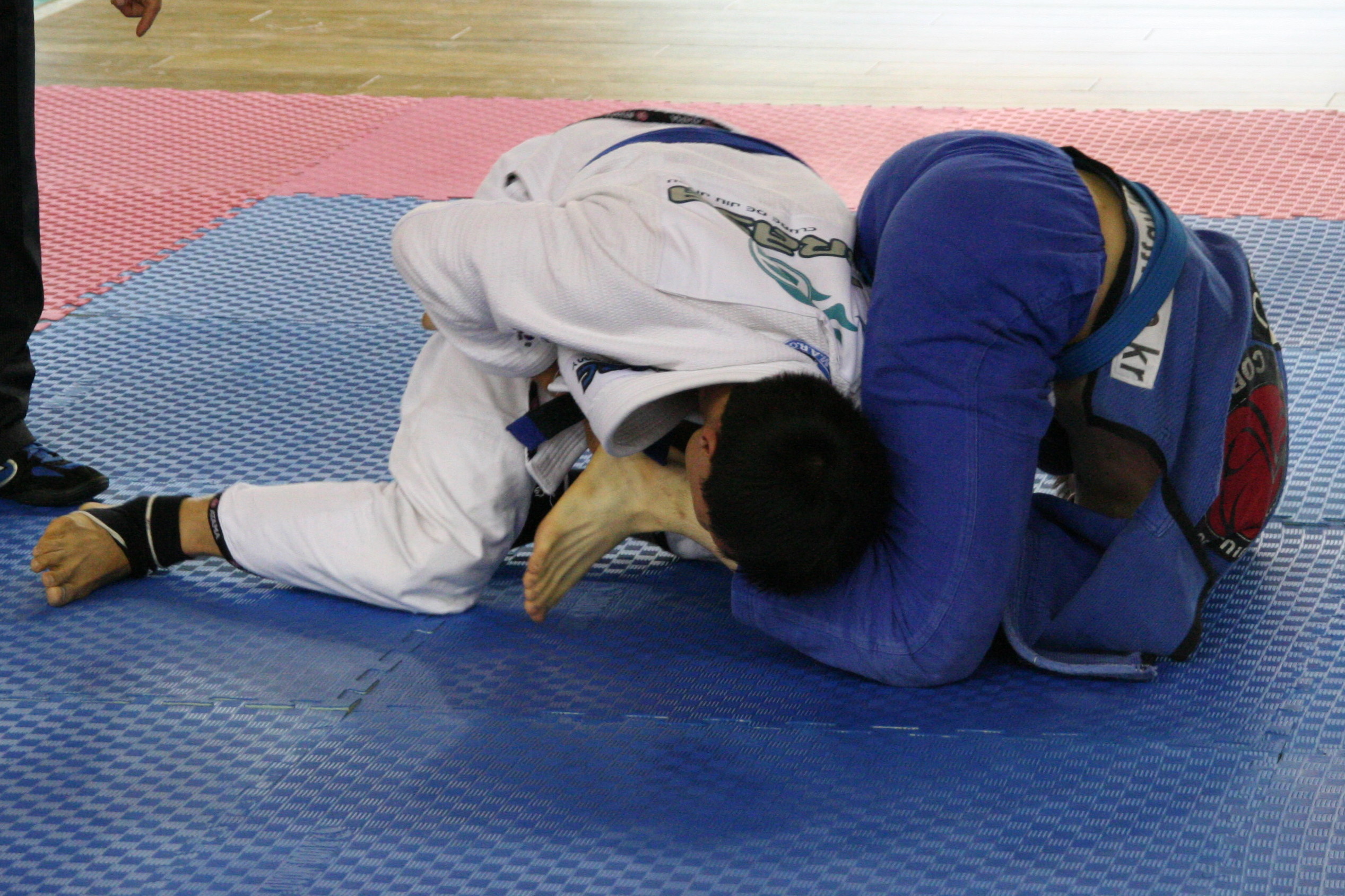
2. Breakdown: frame, pull, feed, tighten
Worm Guard usually starts from open guard or seated guard, and the entry breaks down into four phases:
| Phase | Key points |
|---|---|
| ① Frame the leg | Place the lead leg on the opponent's hip or set a De La Riva hook to fix the angle, establishing initial distance and structure |
| ② Pull the lapel | With the same-side hand, pull the opponent's lapel free from their belt, ready to feed it around your lead leg |
| ③ Feed it around | Feed the lapel around the inside of your lead leg and through behind the opponent's other leg, forming a wrap |
| ④ Tighten | Catch the tail of the lapel with your other hand and pull it tight, completing a structure where one lapel locks both the opponent's leg and torso |
Once the structure is set, the guard player can apply continuous downward and lateral tension on the lapel, forcing the opponent's weight forward and breaking their base. That is the shared launching point for the sweeps, back takes and leg entanglements that follow.
3. Entry timing and setups
First, when you are losing the grip battle. This is exactly the situation that produced the position: when your hand grips are being shut down completely and you cannot find an effective point of control, grabbing the opponent's loose lapel is often the last remaining way to establish anything at all.
Second, as an extension of De La Riva or seated guard. If the lead leg has already fixed the angle with a DLR hook or a hip frame, pulling and feeding the lapel simply adds a lock line on top of an existing structure, which makes the transition relatively natural.
Third, after defending a pass attempt and resetting your guard. When an opponent forces a pass but does not fully complete it, the guard player can often feed the lapel on the way back, flipping a passive defensive moment into active structural control.
4. Strengths and limits
| Strengths | Limits |
|---|---|
| Control does not depend on grip strength, so a smaller or weaker player can still hold guard through structural tension | Depends entirely on the gi lapel; under no-gi rules (including ADCC) the whole system is unusable |
| One lapel controls the leg and torso at once, so the opponent cannot free themselves by prying open a single hand | If the opponent keeps the lapel tucked tight with no slack, there is nothing usable to pull free |
| Chains naturally into sweeps, back takes and leg entanglements for a complete attacking sequence | Steep learning curve; without the wrapping details dialled in you tangle yourself before you tangle your opponent |
| As a control-based guard, no IBJJF rule restricting it by belt level has been found | If the opponent breaks the grip or holds a stable low stance before the wrap completes, the structure comes apart quickly |
5. Common counters and passes
The window for beating Worm Guard sits in the phase where the lapel has not finished its wrap and the structure has not tightened:
First, break the grip early. Strip the opponent's hand grip the instant they pull the lapel free or start feeding it, so the lapel never closes into a full wrap. This attacks the problem at its root, but the timing window is short, which makes execution demanding.
Second, stay in a low crouched stance and deny the travel space. Hold a stable crouched base and close the gap between you and your opponent so the lapel simply lacks the distance it needs to travel around your leg and complete the wrap.
Third, use posture and cross-face pressure to transition into half guard. Maintain a solid upper-body posture and apply pressure with your arm across the opponent's face or the side of their neck (cross-face) to make them release the lapel structure, then step over the leg they are hooking with and settle into half guard. Passing specialists such as Rodolfo Vieira have also filmed instructional demonstrations aimed specifically at this system.
What the guard player does after the structure comes apart
Once the lapel is stripped or pulled away, do not waste time forcing the wrap back on. Retreat to a plain De La Riva hook or recompose your legs to rebuild distance, and focus on keeping the guard structure intact rather than chasing that one lapel.
If the opponent's weight tips forward during the strip and they expose an opening, that is usually the moment to switch to single leg X or hunt a sweep directly, which is far more efficient than trying to rebuild the wrap.
6. How often it shows up in competition
Because the system depends entirely on the gi lapel, Worm Guard cannot appear at the no-gi ADCC World Championship by rule. Its stage is limited to gi events such as IBJJF Worlds, the Pan Ams and World Pro, plus day-to-day academy training. IBJJF and ADCC publish only placings and match results, not usage statistics for individual guard systems, so there is no verifiable official figure for what share of guards Worm Guard represents. What is clear is that ever since Keenan showcased the system at elite events through 2013 and 2014, the lapel guard family has remained a subject that gi instructional content keeps being produced around, and several jiu-jitsu media outlets and online course platforms list it among the lapel control systems modern passers need to prepare for. On the rules side, Worm Guard is a control-based guard, not a submission, and as of an August 2026 check no IBJJF rule restricting it by belt level was found.
7. Safety notes
Worm Guard is not a submission, so the risk of direct joint injury is comparatively low. The main risks come from two directions: holding an externally rotated hip and a hooking angle for long stretches can load the hip joint or groin; and in a scramble your fingers can get caught in the lapel you fed out, causing compression or sprain injuries to the soft tissue of the fingers. For more on stretching and strengthening for hip mobility, see our article on hip mobility training for jiu-jitsu athletes.
・If you feel clear discomfort in the hip or groin, release the structure and reset the angle rather than forcing the wrap to completion
・Watch where your fingers sit while feeding the lapel, so they do not get cinched as your partner rolls out
・If your hip mobility is limited or you have an old injury, talk to your coach about scaling the intensity and adjusting your role in the drill
・If a partner is clearly resisting the wrap and going rigid, slow the pace down so neither of you loses balance and falls in the tug of war
FAQ
Can white belts train Worm Guard?
Yes. Worm Guard is a control-based guard rather than a submission, and as of an August 2026 check there is no IBJJF rule restricting it by belt level. That said, it involves a lot of fine lapel-feeding detail, so it is worth getting comfortable with basic grip fighting and the De La Riva hook first. Otherwise you tend to tangle yourself up in a scramble instead of controlling your opponent.
Is Worm Guard gi-only?
Yes, it depends entirely on the gi lapel, so no-gi rule sets including ADCC make the whole system impossible. That is why its stage is limited to gi competition and gi training, and why you need a different control method the moment you take the jacket off.
How do I pass when my opponent wraps me in Worm Guard?
The core principle is to solve it before the lapel finishes its wrap. You can break the grip the instant your opponent pulls the lapel free, stay in a low crouched stance that denies the lapel room to travel, or use a stable posture plus cross-face pressure to make them release the structure before you step over their hooking leg into half guard. All three share the same idea: never fight a lapel that has already tightened.
How is Worm Guard related to De La Riva Guard?
Worm Guard usually grows out of the De La Riva structure: the lead leg's DLR hook creates the angle and distance first, then the lapel is pulled free and fed around. Reverse the direction of the wrap and you get the common Reverse De La Worm variation, so it is best seen as the De La Riva system with a lapel lock added on top. For more on the hooking structure, see our De La Riva field guide.
Does training Worm Guard cause injuries?
Worm Guard is not a submission, so the risk of direct joint injury is low, but holding an externally rotated hip and a hooking angle for long stretches can load the hip joint or groin, and in a scramble your fingers can get caught in the lapel you fed out. If your hip mobility is limited or you have an old injury, talk to your coach about scaling the intensity of your reps.
References
1. Wikipedia. Keenan Cornelius. en.wikipedia.org (accessed 2026/08; supports the birth date and place, academy history, the 14 September 2013 black belt promotion by André Galvão, the IBJJF and ADCC medal record, and the claim that Galvão named Worm Guard)
2. Graciemag (republished by Sensobjj). Keiko Stars: Keenan Cornelius' phenomenal mark on Jiu-Jitsu history. graciemag.com (accessed 2026/08; supports the 2012 purple belt "double grand slam", with gold in both weight class and absolute at the World Championship, Pan Ams, European Open and Brazilian Nationals in the same year)
3. FloGrappling. Keenan Cornelius Discuss the Origins & Evolution of the Worm Guard. flograppling.com (accessed 2026/08; supports the invention story details, including its creation while training with JT Torres, the original name Marionette Guard, JT Torres banning the stalling version, and Keenan avoiding it in purple and brown belt competition, as well as the variations that evolved from it)
4. BJJ World. Worm Guard: The Evolution Of BJJ's Most Annoying Guard. bjj-world.com (accessed 2026/08; supports the setup steps of framing, pulling, feeding and tightening, the control advantages, and passing counters such as Buchecha breaking the grip and Malfacine holding a crouched stance)
5. Grapplearts. How to Pass 'Worm Guard'. grapplearts.com (accessed 2026/08; supports the overall description of the lapel wrap control mechanism and the account of Rodolfo Vieira filming instructional demonstrations against this system)