 YR Sports Lab
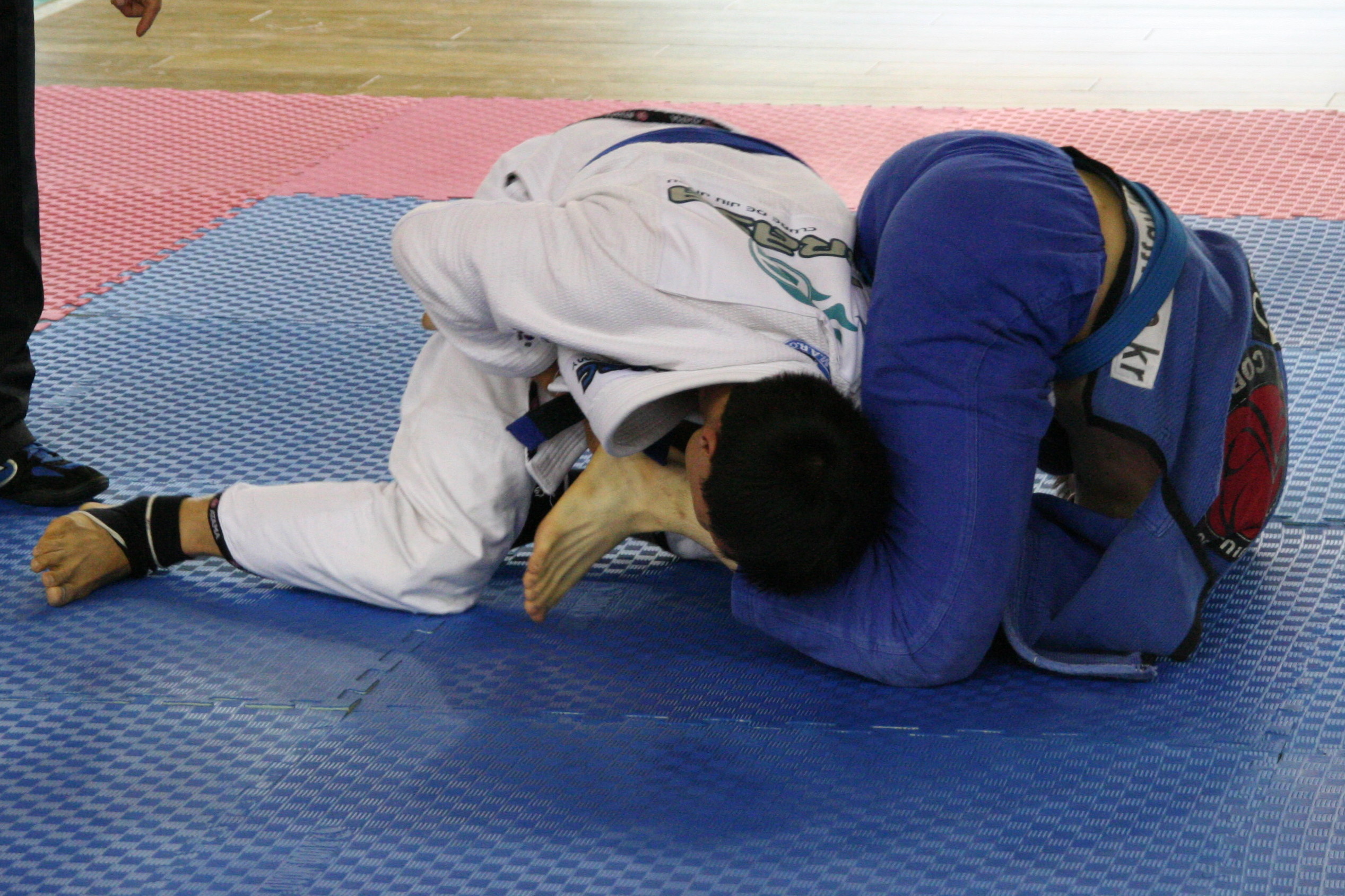
The Choi Bar (inverted armbar) is one of the trickiest angles in the armbar family. It is usually launched from half guard or butterfly guard by hooking a leg over the opponent's shoulder, clamping both hands above the elbow and finishing with a hip bridge. Because the attacking angle differs from a standard armbar, opponents often never feel the familiar pressure cues, and by the time they do it is already too late to react. This guide starts with the story of an unknown Korean black belt who stumbled into the technique, then breaks down the Gable grip plus shoulder-hook finish, three entry windows, its strengths and limits, the common escapes, and the record-fast finish it produced at the 2022 ADCC.
1. Origins: a technique built by an unknown black belt
The Choi Bar takes its name from the Korean Brazilian jiu-jitsu black belt Yongwon Choi (also written Choi Won Choi). Unlike many techniques named after famous champions, Choi was not a decorated competitor when he developed it. Instructional sources note that he was already experimenting with the movement while still at a lower belt, and the earliest recorded footage of the technique currently traceable dates to 2008.
What really put the Choi Bar in front of the mainstream jiu-jitsu world was Choi joining the Atos Jiu-Jitsu academy in the early 2010s. Instructional sources note that Atos at the time had assembled a roster of elite competitors, among them Andre Galvao and Rafael Mendes, who both adopted and promoted the movement. Atos's own official history page likewise lists the Choi Bar alongside the 50/50 guard, the leg drag and the berimbolo as one of the academy's signature contributions to the technical evolution of modern jiu-jitsu. The two sources cross-confirm the link between the Choi Bar and Atos, and explain how the move went from an in-house oddity to an armbar variation taught in academies worldwide.
Not invented by a champion, but spread on champions' stages
In most technique profiles the protagonist first makes a name through competition results, and the technique gets famous alongside him. The Choi Bar is the reverse. Its creator, Yongwon Choi, was never a household-name champion; the move got noticed and systematised worldwide because already-established competitors such as Andre Galvao and Rafael Mendes showcased it on elite stages. That is a useful reminder that a technique's value is not necessarily proportional to its inventor's fame.
One clarification: the Choi Bar has nothing to do with Hong-man Choi, the two-metre-plus Korean fighter known from K-1 and mixed martial arts. The shared surname is pure coincidence, and the two men come from entirely different combat-sports worlds.
2. Mechanics: the structure of an inverted armlock
The Choi Bar began as a version Choi developed in gi competition, using lapel and sleeve grips from open guard. A no-gi entry from Z-guard was developed later, and instructional material also lists entries from half guard, butterfly guard and other bottom guard positions. Instructionals break the full sequence into the following stages:
| Stage | Key points |
|---|---|
| ① Break the opponent's posture | Use your grips to pull the opponent's upper body toward you, breaking the posture they need to pass or pressure, and creating space to attack |
| ② Far-side underhook plus shoulder hook | Thread an arm under the opponent's far armpit to form an underhook, while hooking your inside leg over their shoulder |
| ③ Gable grip above the elbow | Join both hands into a Gable grip above the opponent's elbow, with your own elbow framing against the side of their neck |
| ④ Hip escape to create the angle | Shrimp out laterally to build the angle, aligning the opponent's arm with the axis of your body |
| ⑤ Hip bridge to finish | Plant the foot on the opponent's shoulder and bridge the hips into the lock, switching the hands to grip around their thumb and wrist to lock it in |
Instructional sources stress that getting the foot genuinely planted on the opponent's shoulder is the make-or-break step: without it, the bridging angle never lines up with the opponent's elbow joint, and in their phrasing, "without that step there is no armbar." Because the shoulder hook plus the Gable grip are the two features that most clearly separate this from a standard armbar, most instructionals also branch from the same control position into a triangle choke or a kimura.

3. Entry windows and setups
There are three common windows to launch the Choi Bar:
First, when the opponent tries to pressure pass from half guard or Z-guard. To pass, they shift their weight forward, and in that instant the far arm often reaches out for a grip or posts on the mat, dropping straight into the range for the underhook and shoulder hook.
Second, as a counter to the double under pass. When the opponent threads both arms under your legs to start the pass, their arms are momentarily unprotected, which instructionals list as one of the classic Choi Bar counter windows.
Third, from lapel and sleeve control in open guard in gi competition. This is the original version Choi first developed, using the extra grips the gi provides to build control before transitioning to the shoulder hook and Gable grip.
4. Strengths and limitations
| Strengths | Limitations |
|---|---|
| The attacking angle differs from a standard armbar, so opponents rarely feel the pressure cues early and have less time to defend | Needs a precise Gable grip position and shoulder-hook angle; miss either detail and the finish will not come |
| No need to first secure mount, side control or another dominant position; it launches from relatively passive positions such as half guard and butterfly guard | Less systematised than the traditional armbar, and most academies still treat it as an advanced variation rather than core curriculum |
| Works in both gi and no-gi, and chains onward into the triangle choke, kimura and other submission paths | Demands more joint and hip mobility, so athletes with different body types or flexibility levels pick it up at very different rates |
5. Common escapes and counters
Escaping the Choi Bar works differently from escaping a standard armbar, and instructional sources explicitly warn against ripping the arm out by force:
First, rotate the thumb to change the angle of force. This is the escape technical sources agree on: by rotating the wrist and the direction of the thumb, you strip the leverage out of the opponent's grip rather than fighting the pull head-on.
Second, glue the elbow in to shrink their working space. Before the opponent completes the Gable grip, bring your elbow as close to your own body as possible, reducing the lever length they have to work with.
Third, call it or tap early rather than gambling on a last-second reaction. Because the pressure cues arrive later than in a conventional armbar, by the time it hurts you are usually already close to the end of the joint's range, leaving less reaction time than a standard armbar allows.
What to chain into once the opponent defends the Gable grip
If the opponent protects the elbow and the grip never closes, instructionals often suggest flowing the control into a triangle choke, since the leg hooked over the shoulder is already close to the triangle's starting position.
If the defender pulls the arm back in tight to their body, you can switch to gripping the wrist and upper arm for a kimura-style shoulder lock. The same control position offers more than one submission path, so there is no need to grind away at a single angle.
6. Competition frequency and legality
The Choi Bar is a variation within the armbar family. IBJJF and ADCC only publish placements and match results and do not release technique-level usage or success-rate statistics, so there is no verifiable official figure for "what percentage of submissions are Choi Bars." What can be referenced is the baseline for the armbar family at major events: according to FloGrappling's tally of the 2019 ADCC World Championship (retrieved 2026/08), 3 of the 35 submissions that year were armbars, roughly 8.6%, tied for third with the guillotine and behind only the rear naked choke and the heel hook.
The Choi Bar's own most famous competition example is Craig Jones finishing one from Z-guard against Joao Costa at the 2022 ADCC World Championship. BJJee's event coverage ranked it among the fastest submissions in ADCC history; Costa dislocated his elbow while trying to muscle the arm free and ultimately submitted verbally.
On the rules side, as of IBJJF rule summaries retrieved in 2026/08, elbow locks (including armbar-type techniques) do not appear on any belt-restriction list and are listed as legal even in the kids divisions. In the adult divisions they are available in both gi and no-gi, from white belt to black belt, with no belt or ruleset restrictions.
7. Safety notes
The injury risk of the Choi Bar is the same as that of a standard armbar: damage from hyperextension of the elbow joint. The difference is that because the angle is more deceptive, the person caught in it often realises late that the pressure is near the limit, leaving less reaction time than a conventional armbar. That was the decisive factor in the Craig Jones versus Costa match, where the opponent chose to rip the arm out rather than tap and ended up with a dislocation.
On the mechanism of elbow injuries from armbar-type techniques, a 2017 case series published in Acta Ortopédica Brasileira analysed 5 high-level jiu-jitsu athletes injured by armbars (PMID 29081707). MRI showed that the damage was concentrated in the medial complex of the elbow, involving the common flexor tendon and the ulnar collateral ligament, accompanied by bone bruising of the distal humerus and olecranon. The authors identified the primary mechanism as elbow hyperextension with the forearm held in neutral rotation. For a fuller treatment of the injury mechanism and rehab protocols for armbar-type techniques, see our armbar deep dive and elbow hyperextension guide.
・The angle is deceptive, so tap as soon as you feel pressure instead of waiting for clear pain
・When caught, never rip the arm out by force; the correct escape is rotating the thumb to change the angle of force
・Apply the bridging pressure progressively in drilling, never in a sudden spike for the sake of speed
・With partners who have limited joint mobility or who are meeting this angle for the first time, slow down and keep checking in with them
FAQ
Can white belts train the Choi Bar?
Under the rules, yes. The Choi Bar is a form of elbow lock, and IBJJF rule summaries show that elbow locks (including the standard armbar) carry no belt restriction; they are legal even in the kids divisions, so adult divisions are not an issue at all. In practice, however, most instructional material suggests building a solid foundation in the grips and leg clamp of the traditional armbar first, then learning this variation, which needs a precise Gable grip plus a foot on the shoulder to finish, so you do not stall halfway through because a detail was missed.
How is the Choi Bar different from a regular armbar?
A regular armbar is usually finished from mount or guard by straightening the arm along a familiar line, while the Choi Bar is the inverted version, typically launched from half guard or butterfly guard by hooking a leg over the opponent's shoulder, clamping a Gable grip above the elbow and finishing with a hip bridge. Because the attacking angle differs from a standard armbar, the opponent often never feels the familiar armbar pressure cues and reacts too late.
If someone catches me in a Choi Bar, should I tap immediately or can I fight out?
Tap early or attempt a safe escape rather than ripping the arm free. Technical sources state that the correct escape is to rotate the thumb to change the angle of force, not to yank the arm against the lock. At the 2022 ADCC a competitor tore his arm out by force, dislocated the elbow and had to submit verbally, which shows that muscling against this angle is riskier than against a conventional armbar.
Is the name Choi Bar connected to the very tall Korean fighter Hong-man Choi?
No connection at all, just a coincidental shared surname. The Choi Bar is named after the Korean Brazilian jiu-jitsu black belt Yongwon Choi (also written Choi Won Choi) who developed it, and he is an entirely different person from Hong-man Choi, the two-metre-plus fighter known from K-1 and combat sports rings. There is no technical or lineage link between them.
References
1. JiuJitsu Legacy. The Choi Bar: A Beginner's Guide For This Dynamic Submission. jiujitsulegacy.com (retrieved 2026/08; supports the attribution to Yongwon Choi, the 2008 earliest footage, the promotion by Andre Galvao and Rafael Mendes after he joined Atos, and the underhook, Gable grip, shoulder hook and hip bridge structure described here)
2. BJJ Fanatics. Choibar by Yongwon Choi. bjjfanatics.com (retrieved 2026/08; cross-confirms with reference 1 that Yongwon Choi is a black belt and that the Choi Bar system can be entered from Z-guard, half guard, butterfly guard and gi open guard)
3. Atos Jiu-Jitsu HQ. History. atosjiujitsuhq.com (the academy's official history page, retrieved 2026/08; cross-confirms with reference 1 the link between the Choi Bar and Atos, listing it alongside the 50/50 guard, leg drag and berimbolo as signature Atos contributions to modern jiu-jitsu)
4. BJJee. Craig Jones' "Choi Bar", 2nd Fastest Submission at the ADCC. bjjee.com (retrieved 2026/08; supports the 2022 ADCC Craig Jones versus Joao Costa lightning finish, the opponent's elbow dislocation from ripping the arm free, and the point that rotating the thumb is the correct escape)
5. FloGrappling. ADCC By The Numbers: Submission Rates, Trends & More. flograppling.com (third-party tally, 2019 data, retrieved 2026/08; supports the figure of 3 armbars among 35 submissions at the 2019 ADCC World Championship, roughly 8.6%, tied for third with the guillotine)
6. JiuJitsu News. A Complete Guide to IBJJF Legal and Illegal Submissions. jiujitsu-news.com (2025 IBJJF rule summary, retrieved 2026/08; supports the point that elbow locks are absent from IBJJF belt-restriction lists and are legal in the kids divisions)
7. Almeida TBC, Dobashi ET, Nishimi AY, et al. (2017). Analysis of the pattern and mechanism of elbow injuries related to armbar-type armlocks in Jiu-Jitsu fighters. Acta Ortop Bras;25(5):209-211. PubMed PMID 29081707 (supports the finding that armbar-type techniques mainly damage the medial complex of the elbow, with hyperextension under neutral forearm rotation as the mechanism)