 YR Sports Lab
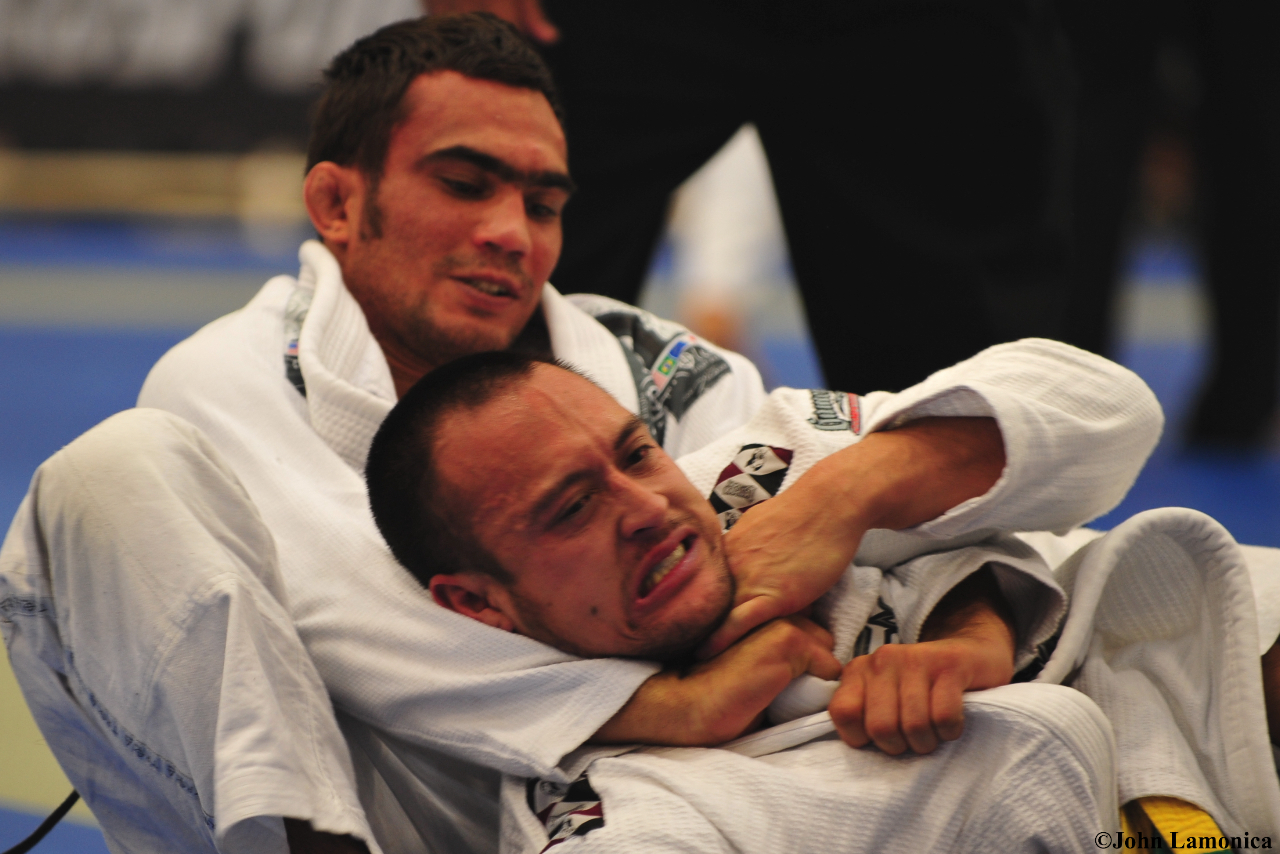
You are controlling the back, hooks in, seatbelt locked, and you are working out how to finish. Then your partner turns ninety degrees, throws a leg over your shoulder, and pulls your whole collar across your throat. That is the Bow and Arrow Choke: a collar choke that looks like drawing a bow, descended from judo's okuri-eri-jime in the Kodokan list. This guide covers its judo lineage, the three control points, the turn-and-arch finish, four common entries, escapes, and why this article gives no single-technique competition percentage.
1. Origins and Name: Choking with the Opponent's Own Collar
Bow and arrow corresponds in judo to okuri-eri-jime, usually translated as the sliding lapel strangle. It is one of the twelve strangles (Shime-waza) of Kodokan judo (Wikipedia, queried 2026/10). A Kodokan-style glossary puts it plainly: the technique chokes the opponent with his own collar. From behind or the side, one arm wraps under the throat and grips the far collar, the other passes under the armpit to grip the other collar, and both hands pull inward.
The Name: A Bow and an Arrow
The English name comes from the finishing shape: the attacker pulls the collar with one hand and the opponent's leg with the other, bending back like a bow. Low Kick MMA adds that in Portuguese the technique is called berimbau, after the Brazilian musical bow.
About an inventor: none of the sources I read points to a single inventor or a signature match, so this article deliberately does not invent a backstory. What can be confirmed is the judo lineage: okuri-eri-jime is one of the twelve Kodokan strangles, and Wikipedia's okuri-eri-jime entry lists the bow and arrow choke among its related variants.
In other words, judo's okuri-eri-jime is a basic strangle that squeezes both collars inward from behind. BJJ players added a turn and control of one leg, turning the choke from an arm squeeze into a full-body draw of the bow. Judo teaching also notes that when the opponent lies prone with the neck retracted, the attacker can hook the legs around from behind and bend the opponent backward, an idea that echoes the BJJ lean-back finish.
2. Mechanics: Three Control Points and the Turn
Student of BJJ breaks the choke into three control points: the upper body (the choking arm plus the leg over the defender's shoulder), the mid-section (the other leg controlling hips and core), and the lower body (a grip on the pants or an underhook on the leg). With all three in place, the defender can neither turn out nor tuck in.
| Phase | Key points |
|---|---|
| 1. Collar grip | The choking hand grips the far collar deep, thumb inside, with the lapel under the chin rather than over it |
| 2. Create space and rotate | Make a small gap, then rotate toward the space between the head and the leg, about 90 degrees, so you sit perpendicular to the opponent |
| 3. Grab the leg | Grip the pants near the knee and control the leg itself, not just fabric, so the opponent cannot turn into you |
| 4. Leg position | One leg crosses the shoulder (or sits behind the head), the other controls hips and core, fixing the pivot of the bow |
| 5. Draw the bow | Lean back, pull the collar and the leg with both hands while pushing with both legs, using whole-body extension rather than arm strength |
Student of BJJ stresses that the choke "isn't just about how hard you can pull with your arms." The squeeze comes from pulling in with the hands and pushing out with the legs at the same time, with the spine elongating. That is why the finish does not rest on arm strength alone when the mechanics are right, and why muscling it with the arms alone, without the turn or the leg control, tends to be slow and easy to defuse.
3. Entry Timing and Setups
Across the Low Kick MMA, Student of BJJ and Evolve teaching write-ups, these are the entries mentioned most often:
| Entry position | Typical situation |
|---|---|
| Back control (most common) | Hooks and seatbelt are in, but the defender protects the neck with chin and hands, so you switch to collar plus leg control for a new angle |
| Turtle | Against a turtled opponent, a commonly taught entry: grip the collar and control the leg without first establishing full back control |
| Mount or side control transitions | While stepping from side control to mount, grip the collar and rotate into the gap that the transition opens |
| Scrambles and half guard | Evolve shows a half guard entry (demonstrated by Teco Shinzato); a standing start requires first getting behind the opponent, for example after a takedown or an arm drag |
The common logic: when the neck is protected and a straight choke angle is unavailable, the bow and arrow supplies an angle. The turn changes the line of the collar across the throat instead of adding more force.
4. Strengths and Limitations
| Strengths | Limitations |
|---|---|
| Uses body angle and whole-body extension, so it does not rely on out-muscling the opponent | The standard version depends on the collar and is mainly a gi technique; the no-gi version uses wrist and leg grips and is less secure |
| Enters from the back, turtle, mount and more, covering gaps when a straight choke is blocked | Needs a turn and a leg grab; the movement is bigger than a rear naked choke and fails if the defender wins the wrist first |
| Pairs with other back attacks (rear naked choke, cross collar choke) as a complementary threat | Turning leaves the standard back position for a moment, so a failed attempt can give the defender a chance to escape |
5. Common Counters
Student of BJJ's defensive principles boil down to one line: deal with it before the three control points arrive.
First, intervene early and control the wrist with your bottom hand. Pin the gripping hand before the leg crosses your shoulder so the lapel cannot be pulled under your chin.
Second, keep your hips active. On your toes with hips off the floor, the attacker has a harder time holding the rotated angle and swinging the leg over.
Third, answer the lean back. As the attacker falls back, swim your top arm under their armpit, bridge, and turn into their full guard, converting the back exposure into a face-to-face position.
Follow-ups After a Counter
If the defender wins your wrist and you cannot complete the turn. Abandon the rotation, return to standard back control, and go for the rear naked choke or rebuild the seatbelt rather than forcing a half-finished position.
If the defender turns back to face you. Respond with a guard pass or pressure rather than staying stuck at that angle and burning energy.
6. Competition Frequency and Rules
I am deliberately conservative in this section. Some teaching articles call the bow and arrow one of the highest-finishing techniques at high levels, and a figure like "17 of 19 attempts, 89%, Worlds 2019" circulates online, but none of this traces back to auditable source data. When I checked JiuJitsu News in 2026/10, the site had itself withdrawn that number, saying it would not promote a percentage it could not walk to a desk. So this article cites no single-technique success rate.
The official data I can cite is the IBJJF's 2023 World Championships submission breakdown (data year 2023, queried 2026/10): of 47 submissions from the quarterfinals to the finals, 21 were chokes from the back, 44.68%, the largest single category. The report only lists the broad "choke from the back" category and does not separate the bow and arrow from rear naked or collar chokes, so all we can say is that the category matters a great deal at the top level and the bow and arrow is one of its tools; its individual share is unknown.
Rules: Collar Chokes Are Basic Submissions
According to JiuJitsu News's summary of the June 2024 IBJJF rules, collar chokes are among the basic submissions available to adult white belts. That summary does not list the bow and arrow individually, so the safe statement is "the collar choke category is legal", not an item-by-item official confirmation. IBJJF rules change every year, so check the current official rulebook before you register.
7. Safety Notes
Like the rear naked choke and the cross collar choke, the bow and arrow is a blood choke acting on the carotid arteries. Koiwai's 1987 review in the Journal of Forensic Sciences states that a properly applied judo strangle causes unconsciousness in about 10 to 20 seconds, and the author reports that no shime-waza fatalities had been recorded in judo since its founding in 1882. That is exactly why you release the instant your partner taps; do not hold on to double-check. For fuller blood-choke safety principles see our choke safety guide, and for the neck and injury side of this choke see the older article Bow and Arrow Choke: injury guide. Two sister finishes from back control are covered in the Rear Naked Choke guide and the Cross Collar Choke guide.
・Release immediately on the tap, in sync with the signal
・Beginners should build the control points and grip first, then add the lean-back pull gradually, never full power from the start
・Partners can tap during the grip and leg-control stage; there is no need to wait for a full squeeze
・If your partner suddenly goes limp or unresponsive, release at once and call your coach rather than waiting to confirm
FAQ
Was the Bow and Arrow Choke invented in BJJ?
No, it comes from judo. Bow and arrow corresponds to okuri-eri-jime in the Kodokan strangle list, whose defining feature is choking the opponent with their own collar. The sources I found do not point to a single inventor, so this article does not name one and only confirms the judo lineage and the origin of the name.
Do you need a gi to do the Bow and Arrow Choke?
The standard version needs a gi collar, so it is mainly a gi technique. Teaching sources describe a no-gi adaptation that swaps the collar for a wrist grip and the pants grip for a leg grip. Without collar friction and fixation, the finish is not as secure as the gi version.
How do you escape the Bow and Arrow Choke from back control?
Act early: deal with it before their leg crosses your shoulder and all three control points arrive. Control their wrist with your bottom hand and keep your hips active on your toes. When they lean back, swim your top arm under their armpit, bridge, and turn into their full guard. Escaping after the grip is complete is much harder.
Can white belts use the Bow and Arrow Choke?
According to JiuJitsu News's summary of the June 2024 IBJJF rules, collar chokes are among the basic submissions available to adult white belts, though that summary does not list the bow and arrow individually. Rules change yearly, so check the current IBJJF rulebook and ask your coach before you register.
How often does the Bow and Arrow Choke appear at Worlds?
There is no auditable per-technique figure that I could find. The IBJJF's official 2023 Worlds breakdown only reports a broad "choke from the back" category: 21 of 47 submissions from the quarterfinals to the finals (44.68%). The bow and arrow is not split out, so this article gives no single-technique percentage.
References
1. Kodokan judo glossary. Okuri-eri-jime (Sliding collar strangle). judo-ch.jp (queried 2026/10; supports the name "chokes the opponent with his own collar" and the basic method of gripping both collars from behind or the side)
2. Wikipedia contributors. Okuri eri jime. en.wikipedia.org/Okuri_eri_jime (queried 2026/10; supports its place among the twelve Kodokan Shime-waza, the translation "sliding lapel strangle", and the bow and arrow choke listed among its related variants)
3. Student of BJJ. Bow and Arrow Choke. studentofbjj.com (queried 2026/10; supports the three control points, lapel under the chin, the pull-with-arms push-with-legs finish, and the escape principles of acting early, controlling the wrist, active hips and swimming the arm)
4. Low Kick MMA. Bow And Arrow Choke: BJJ Submission Explained. lowkickmma.com (queried 2026/10; supports rotating between the head and the leg, gripping the leg and pulling the collar, the Portuguese name berimbau, and entries from the back, turtle, mount and side control)
5. Evolve Daily. How To Complete The Bow And Arrow Choke In BJJ. evolve-mma.com (queried 2026/10; supports the thumbs-inside collar grip, pants grip near the knee, rotating about 90 degrees before leaning back, and the half guard, standing and no-gi notes)
6. IBJJF. 2023 World Championships Submission Breakdown. ibjjf.com (official IBJJF statistics, data year 2023, queried 2026/10; supports 21 of 47 quarterfinal-to-final submissions being chokes from the back, 44.68%, with no separate bow and arrow entry)
7. JiuJitsu News. A Complete Guide to IBJJF Legal and Illegal Submissions. jiujitsu-news.com (third-party summary of the June 2024 IBJJF rules, queried 2026/10; supports collar chokes being basic submissions for adult white belts, with no individual listing of the bow and arrow)
8. JiuJitsu News. 17 Most Effective BJJ Submissions: Statistics & Success Rates. jiujitsu-news.com (third-party article, queried 2026/10; states it no longer promotes the earlier "17/19 at Worlds 2019, 89%" figure, which is why this article cites no single-technique success rate)
9. Koiwai EK (1987). Deaths allegedly caused by the use of "choke holds" (shime-waza). J Forensic Sci;32(2):419-32. PubMed 3572335 (supports unconsciousness in roughly 10 to 20 seconds when a judo strangle is properly applied, and the author's statement that no shime-waza fatalities had been reported in judo since 1882)