 YR Sports Lab
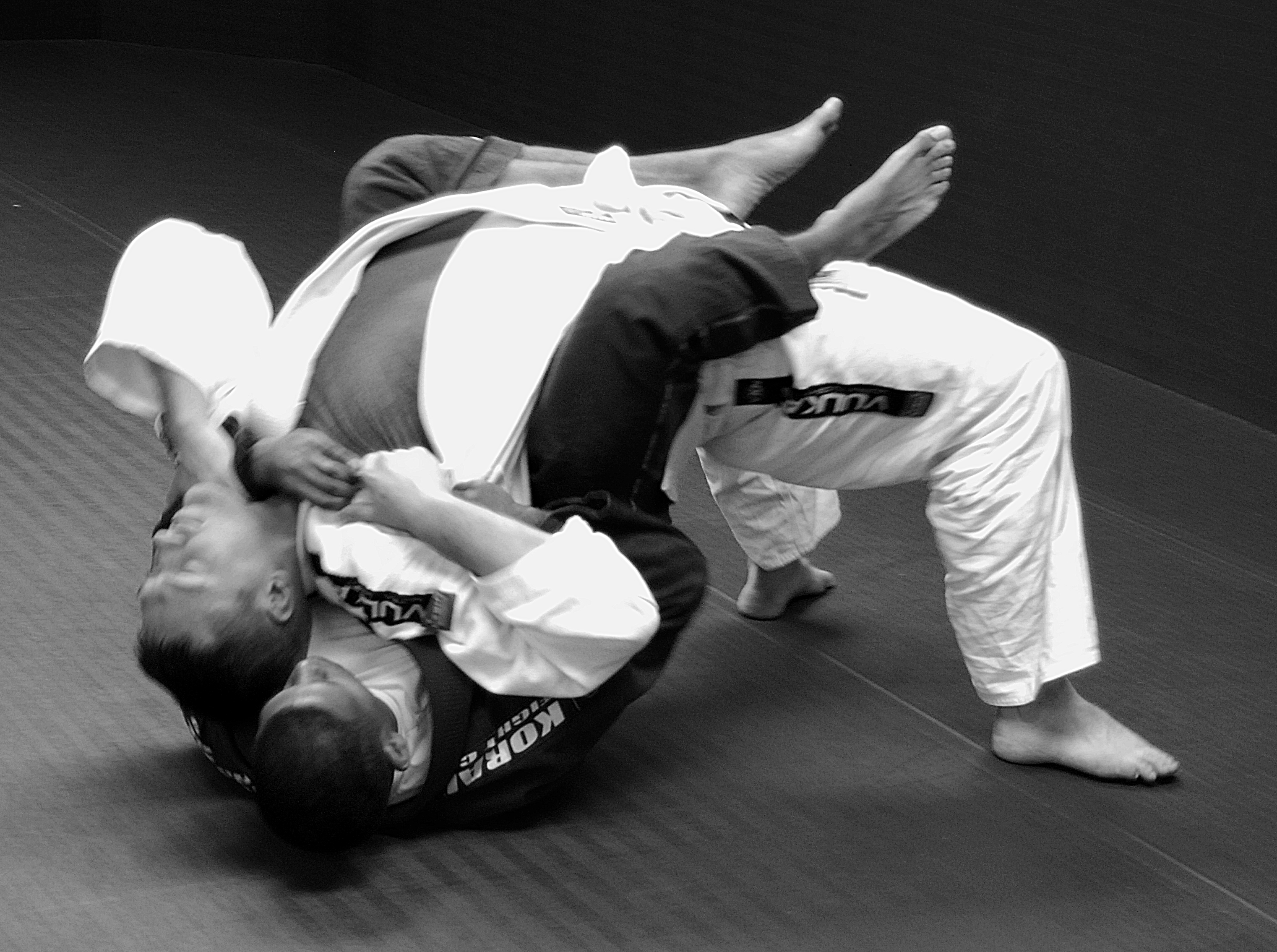
The arm drag is originally a basic wrestling tie-up technique: grab an opponent's arm, pull it across your own body, and step around to their back while they're off balance and turning. The move has been a staple of stand-up wrestling for a long time, but once it crossed over into Brazilian jiu-jitsu and no-gi grappling, it became one of the most important bridges between standing exchanges and ground control. The competitor who really turned it into a signature weapon at the highest level was four-time ADCC World Champion Marcelo Garcia, who used it again and again through the 2000s to drag opponents to his back and finish them, turning the arm drag from a wrestling-room fundamental into standard BJJ curriculum. This entry breaks down the mechanics, three typical entry timings, strengths and limits, common counters, and where the move sits in the rules and the competition record.
1. Origins: a move borrowed from wrestling, turned into a back-take weapon by Marcelo Garcia
Unlike the armbar or triangle choke, the arm drag doesn't have a single named inventor. It comes from the standard toolkit of stand-up wrestling: grab an opponent's arm and pull it across to change the angle between both bodies, a basic move taught early in both freestyle and Greco-Roman wrestling. As mixed martial arts and no-gi submission grappling grew, wrestlers brought this move into BJJ and no-gi competition in large numbers, and it became a key link between standing exchanges and ground attacks.
Marcelo Garcia: turning a wrestling fundamental into a four-time ADCC weapon
Marcelo "Marcelinho" Garcia was born on January 17, 1982, in Formiga, Minas Gerais, Brazil. His jiu-jitsu lineage runs from Mitsuyo Maeda through Carlos Gracie, Helio Gracie, Rolls Gracie, and Romero "Jacaré" Cavalcanti to Fabio Gurgel, who awarded him his black belt in 2002; he competes under the Alliance jiu-jitsu team. His competition record is solid: four ADCC World Submission Wrestling Championship titles at -77 kg (2003, 2005, 2007, 2011) and five IBJJF World Championship titles at -82 kg (2004, 2006, 2009, 2010, 2011). After retiring from competition in 2011 he was inducted into the ADCC Hall of Fame, becoming the third competitor to receive that honor after Roger Gracie (biography and titles cross-checked against Wikipedia and Elite Sports).
Garcia's contribution to the arm drag isn't invention, it's refinement: he took a wrestling-room fundamental and turned it into a genuine finishing weapon on jiu-jitsu's biggest stages. At his first ADCC World Championship appearance in 2003, competing in the absolute (open weight) division, he faced Mike Van Arsdale, a considerably larger opponent with an American wrestling background. Garcia hit a clean arm drag to take Van Arsdale's back and finished the submission from there, a classic underdog performance that's still referenced in ADCC retrospectives today. Both Wikipedia and BJJ World credit Garcia by name for introducing and popularizing the arm drag as one of his concrete contributions to modern jiu-jitsu, alongside the X-guard and butterfly guard.

2. Mechanics: from the wrist grip to back control
Pulling together several instructional breakdowns of the standing arm drag, the standard version splits into four stages, with the core principle being to move the drag with your whole body, not just your arm strength:
| Stage | Key points |
|---|---|
| ① Establish the grip | In a standing tie-up, grab the opponent's same-side wrist and cup their triceps with your other hand, locking the whole arm into your control |
| ② Step and pull | Step to the side in the direction the opponent's arm is already extended, pulling the whole arm across your body using body movement, not just arm strength |
| ③ Establish rear control | As the opponent loses balance and turns from the drag, close the distance to their back to establish a standing rear clinch |
| ④ Convert to a back take or takedown | From the rear clinch, jump straight to the opponent's back for control, or drop levels into a takedown, depending on the angle and rhythm in the moment |
Applied from butterfly guard, the same principle plays out from a different starting point: the attacker cups the opponent's triceps while seated, hooks one leg to the outside of the opponent's body, and drives the hips in the same direction to pull the opponent forward, a shift that typically converts directly into a sweep or a back take, and one of Garcia's most common entries in competition.
3. Entry timings and setups
First, the instant an opponent's arm strays from their torso in a standing tie-up. This is the classic entry and also the lowest barrier to entry: any time an opponent isn't tucking their arm tight to their body, there's a window, no elaborate setup required.
Second, the moment you pull an opponent's triceps from butterfly guard. Once the attacker has the triceps grip and a hook outside the opponent's leg, driving the hips at the right moment often opens both a sweep and a back take at once.
Third, from half guard. Instructional sources note that black belt standout Bernardo Faria, one of Marcelo Garcia's representative students, is particularly known for using the arm drag from half guard, applying it as an alternative when a direct pass or sweep isn't available to disrupt the opponent's upper-body posture.
Fourth, as a bridge into a combination. Black belt Keenan Cornelius demonstrates chaining the arm drag directly into a D'Arce choke: he grabs above the opponent's elbow and pulls, forcing them to post with the dragged arm to keep balance, and that exact moment gives his free arm a clean path under the opponent's armpit and around the neck to set up the choke, no reset required to flow from control into a finish.
4. Strengths and limitations
| Strengths | Limitations |
|---|---|
| Low barrier to entry; any brief exposure of an opponent's arm is enough, with no need to first break their posture | Not a finish on its own, only an entry; without an immediate follow-up into control or a takedown, the advantage disappears fast |
| Works in both gi and no-gi; the grips are the wrist and triceps rather than a collar or sleeve, so equipment isn't a limiting factor | If the opponent also controls the attacker's elbow, they can reverse it directly with a "redrag" back onto the attacker |
| Wide range of entries: standing, butterfly guard, half guard, and turtle all use the same underlying principle, giving it real tactical flexibility | Practitioners who haven't drilled the timing often pull the arm but forget to follow with their hips and feet, dragging the arm without ever actually breaking the opponent's balance |
5. Common counters
Instructional platform Grapplearts' breakdown of arm drag defense centers on three main counters:
First, the cross-chest block. The instant you feel your arm being pulled across your body, shoot your free hand between your own torso and the opponent's to block their forward momentum with your forearm, then withdraw the trapped arm to reset your posture. The key is not to leave the arm extended, which hands the opponent a 2-on-1 grip.
Second, the redrag back to the opponent's back. When the defender also has control of the attacker's elbow, they can step the opposite foot forward for a base, grab the attacker's elbow, pivot 180 degrees, and take the attacker's back directly, completely reversing the original attack.
Third, post, pike, and pass. Post both hands on the far side of the opponent's body, extend the legs to pike the hips up, then hop the legs over to land in side control. Timing is the key variable here; too early or too late and the opponent can reset the angle.
Following up when the opponent only half-escapes
When the defender's cross-chest block only partially works, the attacker typically still has the elbow or triceps controlled and can switch to the opponent's far collar or neck and flow into a takedown, rather than releasing the grip and resetting from scratch.
If the opponent successfully redrags, the roles have instantly reversed, and the priority shifts immediately back to the cross-chest block principle, protecting your own back rather than trying to reclaim the original attack.
6. Competition frequency
No governing body, IBJJF or ADCC, publishes standalone statistics for the arm drag itself. That fits its nature as a transitional technique: most public match data only tracks the final submission or takedown, not the intermediate step of how back control was established, so this entry describes its prevalence qualitatively rather than inventing a precise percentage.
Its weight in elite competition, though, is easy to see through Marcelo Garcia's career: he built four ADCC World Championship titles and five IBJJF World Championship titles largely on a back-control-and-choke-centered game, and both Wikipedia and BJJ World explicitly credit him with introducing and popularizing the arm drag as one of his concrete contributions to modern jiu-jitsu, alongside the X-guard and butterfly guard (accessed 2026/09). That's also why most academies still teach the arm drag as part of the basic curriculum: its value isn't captured in a statistic, it's earned through being usable from nearly every position.
On the rules side, the arm drag is a standing control and transition technique, not a submission, so it is not on the IBJJF's white-to-blue belt restriction list, which is built mainly around leg locks, the guillotine from closed guard, and 50/50 guard. Adult and youth competitors at every belt can drill and compete with it freely (as of the 2026 rulebook).
7. Safety notes
The arm drag is a control and positioning technique rather than a joint lock or a choke, so it doesn't put direct pressure on a joint or the airway, and injuries directly caused by the move itself are relatively rare. The real risk tends to show up in the exchange that follows: a defender who stiff-arms against the pull instead of relaxing into it can put unnatural lateral stress on their own shoulder or wrist, and an attacker who rushes the back take or takedown without setting the angle properly can end up going down awkwardly with the opponent and twisting a knee or ankle. That's less a risk specific to the arm drag than a general caution that applies to any technique bridging standing to the ground. For more on shoulder injury mechanisms in jiu-jitsu and how grip fatigue affects defense, see our companion pieces on BJJ shoulder injuries and grip fighting.
・Relax your arm when it's being pulled rather than stiff-arming against the direction of the pull
・Control your pace when finishing to back control or a takedown; don't sacrifice a safe landing to rush the finish
・Beginners should drill the drag-to-position piece slowly under a coach's supervision before adding a takedown follow-up
・If a partner's movement feels out of control, or you lose your own balance, call it or slow down early
FAQ
Can white belts use the arm drag?
Yes. The arm drag is a standing control and transition technique, not a submission, so it is not on any IBJJF belt restriction list. White belts through black belts can drill and compete with it freely, and it is often one of the first moves taught to beginners because the barrier to entry is low: any time an opponent's arm strays from their torso, there's a window to use it.
Does the arm drag work in no-gi?
Yes, and it shows up just as often, if not more, in no-gi. The grips are the wrist and the triceps rather than a collar or sleeve, so it doesn't depend on gi fabric. Standing ties, butterfly guard, and half guard entries all carry over between gi and no-gi, making it one of the few core techniques largely unaffected by the ruleset.
I dragged the arm across but my opponent won't fall or turn. What now?
That means their base hasn't actually been broken yet. The arm drag is only an entry, not a finish, so the priority is to immediately hook the opponent's hip with your free arm or jump straight to their back, converting the moment of the drag into back control rather than waiting for them to lose balance on their own.
My opponent keeps redragging me before I can finish the move. What am I doing wrong?
That's the classic redrag counter, and it usually happens when the opponent also has control of your elbow. The fix is to pivot your hips and cut off their spinning room the instant you complete the drag, rather than just pulling the arm and leaving your own body stationary, which gives them time to grab your elbow and reverse the position.
Does the arm drag only work from standing?
No. Standing is the classic entry, but butterfly guard, half guard, turtle, and even side control can all use the same underlying principle. Any moment an opponent's arm briefly leaves the protection of their torso is a window worth taking.
References
1. Wikipedia contributors. Marcelo Garcia (grappler). en.wikipedia.org (accessed 2026/09; supports Marcelo Garcia's birth date and place, his black belt lineage and Fabio Gurgel promotion, his ADCC and IBJJF World Championship medal years and weight classes, his standing as the third ADCC Hall of Fame inductee, and the record crediting him with introducing and popularizing the arm drag)
2. Elite Sports. Marcelo Garcia, The ADCC GOAT (Greatest of All Times). elitesports.com (accessed 2026/09; cross-checks the black belt lineage, Alliance team affiliation, and ADCC/IBJJF World Championship medal years and weight classes; this page's birth year is one year off from reference 1, so this entry follows reference 1 for the birth year)
3. Elite Sports. The ADCC Names Marcelo Garcia as The Third Hall Of Fame Inductee. elitesports.com (accessed 2026/09; supports Marcelo Garcia being the third competitor inducted into the ADCC Hall of Fame after Roger Gracie; this page's induction year conflicts with reference 1, so this entry does not state an exact induction year)
4. BJJ World. Is Marcelo Garcia The ADCC GOAT? bjj-world.com (accessed 2026/09; supports the 2003 ADCC World Championship absolute division match against Mike Van Arsdale, finished via an arm drag to back control, plus his four ADCC title years and the record crediting him with the arm drag as one of his technical contributions)
5. Grapplearts (Stephan Kesting). 10 Key Techniques and Tactics of Marcelo Garcia. grapplearts.com (accessed 2026/09; supports the standing and butterfly guard versions of the arm drag, the grip and stepping mechanics, and the description of Garcia repeatedly using it at ADCC)
6. Grapplearts (Stephan Kesting). Countering the Armdrag. grapplearts.com (accessed 2026/09; supports the cross-chest block, redrag to back, and post-pike-pass counters and their mechanics)
7. BJJ Fanatics. The Arm Drag for Every Jiu Jitsu Fighter. bjjfanatics.com (accessed 2026/09; supports Keenan Cornelius's arm-drag-to-D'Arce choke combination and the record of Bernardo Faria's frequent use of the arm drag from half guard)