 YR Sports Lab
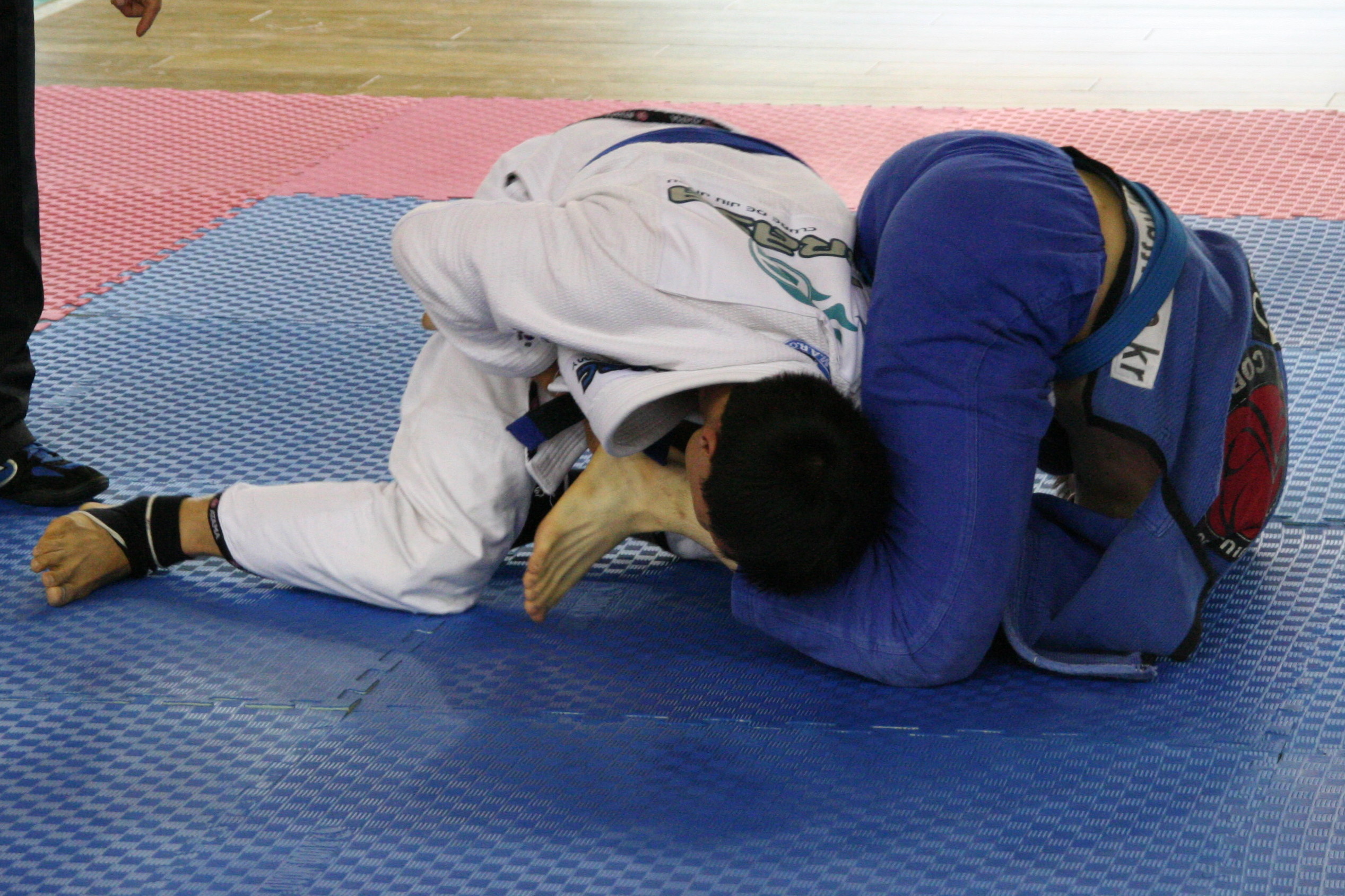
Your opponent is mounted on you and all you want to do is protect your face. A second later his leg swings over your head, he falls back, your elbow is pinned between his thighs, and one hip thrust bends your arm the wrong way. The armbar (juji-gatame, "cross lock", in judo) is the first submission every BJJ practitioner learns and one that elite black belts are still finishing decades later, and it works by pushing the elbow past its normal range of extension. Aggregated competition data show the armbar is the most frequently attempted submission (roughly 19.5% of all submission attempts), finishing about 50% of the time, and it has sat near the top of gi competition statistics for years. Yet the same movement is one of the most common reasons people hurt an elbow in the gym by tapping too late. This article draws on PubMed literature to break down the hyperextension lever, the truth behind that 50% finish rate, the UCL and common flexor tendon injury bill, plus a three-layer escape system and an 8-week elbow stability program.
1. What the armbar really is: pushing the elbow past straight
The armbar is mechanically very simple: it is a lever that forces the elbow into hyperextension. The attacker pins and immobilises the opponent's upper arm with both legs and hips, then drives the forearm and hand toward, and past, full extension. Once the elbow passes its physiological limit, pain and structural tension force the tap. The Japanese name juji-gatame literally means "cross lock", because the attacker's body and the opponent's arm form a cross.
Entries exist from almost every position: mount, closed guard, side control, back control, S-mount, and the triangle-to-armbar switch all lead into it. Because the entries are so numerous and the mechanics so direct, the armbar is taught early in every BJJ curriculum and remains a core technique from white belt to black belt. One key concept: the armbar does not finish on raw strength, it finishes on the anatomical limit of the opponent's elbow. Get the control and the angle right and the lever cancels out a large size difference, which is why the technique is especially friendly to smaller athletes.
But precisely because it acts directly on a joint with almost no spare range and a fragile bony structure, the armbar has a very narrow safety margin. Understanding how the lever works is both the key to finishing it cleanly and the basis for knowing when tapping is non-negotiable.
The three control requirements of the armbar
・Head and body clamp: one leg crosses the opponent's neck or shoulder while the other pins his torso, nailing him to the mat and taking away the space to sit up.
・Knee pinch on the arm: squeeze both knees to lock the opponent's upper arm between your thighs. This is the fixed end of the hyperextension lever, and a loose pinch leaks force out of the whole submission.
・Thumb orientation: turn the opponent's thumb upward (forearm neutral) so the elbow hinge faces your hips squarely. One hip thrust then produces pure hyperextension; the wrong thumb direction turns it into torsion rather than clean extension.
With all three in place, the smallest hip lift takes the opponent to the limit of his elbow in a very short arc. Without the knee pinch the arm slips out; without thumb control the force is scattered into rotation instead of hyperextension, and these are the two main reasons an armbar that "looked locked" never finishes.
2. Hyperextension mechanics: hips as fulcrum, elbow as the segment being bent
To understand the armbar's destructive potential, start with elbow anatomy. The elbow is a hinge joint formed by the humerus, ulna and radius, and a normal adult has only about 5 degrees of physiological hyperextension. The structures that limit hyperextension are the anterior capsule, the ulnar collateral ligament (UCL), the common flexor origin, and the bony engagement of the humerus and ulna. In other words, the elbow was never meant to bend backwards, and the buffer it offers is tiny.
The armbar consumes that small buffer instantly. Its lever breaks into three segments: the opponent's upper arm is the fixed end held between your knees, your hips (pubic bone and upper thigh) are the fulcrum pressed under the elbow, and the opponent's forearm and wrist are the force end you pull downward with both hands. When you straighten the arm and drive the hips up, the elbow is caught between the forearm pulling down and the hips pushing up, producing a pure hyperextension moment. Because the lever arm is the whole forearm and the force comes from the large muscles of the hips and back, this lever easily exceeds what the elbow's structures can tolerate.
Two details are routinely overlooked. First, a thumb-up position (forearm neutral) directs 100% of the moment into hyperextension; the imaging study of armbar-related injuries lists "hyperextension with the forearm in neutral" as the primary injury mechanism (see section 5). Second, the hips must be flush against the opponent's elbow with no gap. The further the hips sit from the elbow, the looser the fulcrum and the more room the opponent has to bend his arm and escape; pin the hips tight and squeeze the knees, and he does not have a centimetre in which to flex. The essence of finishing an armbar is to eliminate every gap and then move the hips only slightly, rather than yanking with brute force, and that is the key to both the success rate and the safety of the technique.
3. The truth behind the 50% finish rate: most attempted, hardest to shut down with one posture
Start with the numbers. Aggregated competition data show that the armbar is the most frequently attempted submission of all, roughly 19.5% of submission attempts, with a finish rate around 50% (68 of 137 attempts in one quantified sample). Among the five core submissions (armbar, rear naked choke, triangle, guillotine and kimura), those five together account for more than 56% of competition finishes. Notably, armbar success rises with skill level: aggregated figures put beginners around 55% and advanced practitioners as high as 75%, making it one of the few techniques that clearly gets better the longer you train it.
| Submission | Competition finish rate | Share of submission attempts | Mechanical category |
|---|---|---|---|
| Armbar | about 50% | about 19.5% (highest) | Elbow hyperextension |
| Rear naked choke (RNC) | about 42% | about 14.4% | Carotid blood choke |
| Triangle | about 38% | about 9.5% | Carotid blood choke, switches to armbar |
| Kimura | about 55–85% | about 6% | Shoulder internal rotation |
| Guillotine | about 9.52% | about 6.6% | Carotid / tracheal compression |
How should that 50% be read? It is neither the kimura's high conversion nor the guillotine's low one, and it reflects two properties of the armbar. First, it has too many entries and threatens too broadly for any single defensive posture to shut it down, which is why attempt frequency ranks first. Second, once the control is complete it is nearly inescapable, but any gap in that control (loose knees, hips away from the elbow, wrong thumb direction) lets the opponent flex the elbow, hide the thumb or hitchhike out, which puts the overall figure at roughly half. In short, the armbar's finish rate depends almost entirely on how clean the control is, not on luck.
One trend is worth noting: aggregated data show the armbar's share of competition finishes drifting slowly downward (from about 19% in 2012–2016 to roughly 13.5% in recent years), commonly explained by the rise of leg lock systems and back-attack frameworks taking a slice of the finishes. That does not dent its status as the king of fundamentals, because the armbar's control principles (knee pinch, hip drive, thumb control) carry over into the triangle, omoplata, armbar sweeps and a whole family of attacks and counters. It is foundational technique you cannot route around.
4. The attack tree: the armbar is never a single shot, it is a web of threats
The armbar's value lies in how numerous and complementary its entries and combinations are. The underlying logic is simple: force the opponent into a dilemma. Defend the arm and you threaten the neck or the position; protect the neck and the arm comes to you. Below are the four most common entries and chains.
Isolate one of the opponent's arms from mount, climb to S-mount, then swing the leg over the head to finish the armbar. If he clings to the arm he usually exposes a collar choke or the back, making this one of the highest-efficiency entries from top position.
From bottom closed guard, break the opponent's posture, control one arm, then pivot the hips to create the angle and swing a leg across the neck line. When he rips the arm out to defend, flow straight into the triangle or an armbar sweep (hip bump family).
The triangle and the armbar share the same leg control and angle. If he hides the arm to defend the triangle, attack the other arm with the armbar; if he protects the arm, go back to the triangle. Each is the answer to the other's escape, the classic dual threat.
Threaten the rear naked choke from back control, and while both his hands are busy defending the neck, isolate one arm and switch to the armbar. The neck-or-arm dilemma is the core of finishing from the back.
Train these four entries as one connected web and the armbar stops being a gamble on a single technique and becomes a reliable attacking system. The practical mindset: once the armbar is on, do not rush to yank. First close the three gaps of knee pinch, hip drive and thumb control, then decide whether to apply slow pressure and finish, or to follow his defence into the triangle, a collar choke or a sweep. The difference behind that 50% finish rate is usually whether the control was executed to 80 points or to 100.
5. The elbow injury bill: UCL and common flexor tendon take the hit
The armbar acts directly on the elbow, so its injury risk sits mainly with the person being submitted, and because the hyperextension buffer is so small, injury often happens in a moment when it does not yet feel very painful.
Imaging evidence: 100% of UCLs and common flexor tendons affected. Almeida et al. (2017, Acta Ortopedica Brasileira) performed MRI analysis on 5 high-level BJJ athletes injured by armbar-type armlocks. The results: ulnar collateral ligament (UCL) tears in 100% (5/5), partial or complete rupture of the common flexor tendon in 100% (5/5), and bone bruising or microfracture of the distal humerus and olecranon in 60% (3/5), accompanied by joint effusion. The study explicitly identifies the primary mechanism as "elbow hyperextension with the forearm in neutral", exactly the thumb-up, hip-driven force path of the armbar. The sample is small, but it maps precisely onto the mechanics of this technique and is one of the few imaging studies aimed directly at it.
The order of structural failure. Tyrdal and Olsen (1998) used a cadaver model to simulate hyperextension loading of the elbow and found that the structures do not fail simultaneously but in sequence: the anterior capsule ruptures first, then the flexor/pronator origin tears in an L-shaped pattern with lengthening of the anterior band of the medial collateral ligament, followed by incomplete tearing of the lateral collateral ligament, and finally small cartilage fragments at the posterior margin of the ulna. Joint laxity could be induced at less than 50 degrees of flexion. This tells us that when an armbar is taken to the end, the elbow is destroyed layer by layer, and by the time severe pain arrives the anterior capsule and ligaments may already be damaged.
Put that back into the wider BJJ injury picture: the large survey by Hinz et al. (2021, n=1,140) identifies the elbow as one of the commonly injured upper-limb joints in BJJ, with armlock techniques the main source of elbow injuries; Scoggin et al. (2014) likewise list elbow hyperextension among the common competition injury mechanisms. Add the consistent finding that roughly 79% of BJJ injuries occur during sparring, and a scenario like the armbar, where the opponent resists hard and the attacker adds force in response, becomes one of the most dangerous moments in a training round.
Key data: armbar-related elbow injuries (PubMed literature)
・Almeida (2017, n=5) MRI: UCL tear 100%, common flexor tendon injury 100%, bone bruise / microfracture 60%, mechanism being elbow hyperextension with the forearm in neutral.
・Tyrdal & Olsen (1998): the hyperextension failure sequence is anterior capsule → flexor/pronator origin plus anterior medial collateral ligament → lateral collateral ligament → posterior ulnar cartilage; laxity can be induced at < 50° of flexion.
・A normal adult elbow has only about 5° of physiological hyperextension, an extremely small buffer.
・About 79% of BJJ injuries occur during sparring, and the elbow is a commonly injured upper-limb joint (Hinz 2021, n=1,140; Scoggin 2014).
What this means for the armbar: the person being submitted should tap the moment the elbow feels driven straight and the arc is nearly finished, not when severe pain arrives, because the structures fail one layer at a time. The attacker, in turn, should apply pressure slowly and give the opponent time to react.
6. Three layers of escape: solve the problem before you are locked in
The earlier you escape an armbar, the easier and safer it is. Once the arm is straightened and the hips are driven home, tapping is all that remains. Below, the defence is split into three layers, ordered from "not yet caught" to "about to be finished".
Most armbars start with your opponent isolating one arm. When pinned, keep the elbows tight to the body, never cross an arm over your centreline, and do not push on his hip with a single hand. This is the cheapest possible prevention: if the arm never goes out, the armbar has no fixed end.
As soon as he starts pulling the arm, clasp your hands palm to palm (or grip your own gi or pants), turn the trapped thumb toward him, and bend the elbow hard against the extension. As long as the elbow can flex, the hyperextension moment cannot form. This is the line that buys you time.
Once he has fallen back with the position on, stack your weight into him and pull the trapped-side shoulder free; or use the hitchhiker, rotating the arm thumb-down and following the direction of shoulder external rotation to slide the arm out from between his legs. Both require turning your body, never a straight yank.
When the arm is straightened, flexion has failed and the hips are fully driven in, the only correct option is to tap immediately. The armbar destroys structures layer by layer, and resisting typically buys months of rehab. Tapping is judgement, not weakness.
| Stage of the attack | Your situation | Priority counter | Mechanical reason |
|---|---|---|---|
| He has just isolated the arm | Arm gripped, you can still move | Elbow tight to body, turn toward him | No fixed end means the armbar cannot be built |
| He pivots the hips for the angle | Arm nearly straight, elbow can still flex | Palm-to-palm grip, bend hard | A flexing elbow prevents the hyperextension moment and buys time |
| He falls back, leg across the neck | Position is on but thumb direction still controllable | Stack and free the shoulder, or hitchhiker out | Rotating into shoulder external rotation slides the arm out of the gap |
| Arm straight, hips fully driven in | Flexion failed, arc at its end | Tap immediately | The capsule and UCL are damaged before severe pain arrives |
The practical principle: escape cost rises exponentially with each stage. Layer one takes almost no effort, layer three demands speed and technique, and at the last line only tapping is left. Drilling the reflex of "elbow in, clasp and flex, turn and free" is far more useful than learning ten advanced escapes.
7. Training prescription: an 8-week program for elbow stability, grip and hip mobility
Training the armbar for longevity and clean finishes runs on two lines: as the person defending, you need flexor strength and grip that can protect the elbow under hyperextension load, plus the reflex to bend against extension; as the attacker, you need enough hip mobility and core control to pivot into the angle and complete the control without brute pulling. The four-phase protocol below follows sports-science principles.
Dumbbell biceps curl 3×12, wrist curl 3×15, isometric elbow flexion hold 3×30 seconds. This builds the buffering capacity of the common flexor tendon and elbow flexors under hyperextension load, directly targeting the structures Almeida (2017) identified.
Towel or gi hangs 3×30–45 seconds, gripper 3×15, reverse wrist curl 3×15. The death grip that holds a palm-to-palm clasp during an armbar escape runs on grip strength and forearm endurance: hold on and you have time to bend and get out.
90/90 hip rotations 3×8 per side, pigeon pose 60 seconds, Pallof press 3×10 per side, dead bug 3×10 per side. The attacker's hip pivot depends on hip mobility; open hips mean less brute pulling and a lower risk of being swept.
With a partner at half resistance, run "isolate the arm → set the armbar → add pressure slowly until he taps" 10 times each; on the defensive side, repeat the three-layer reflex of "elbow in → clasp and flex → stack or hitchhiker out", and drill the decision to tap in time along with it.
Focusing training on elbow flexors, grip and hip mobility has a clear evidential logic. Since Almeida (2017) confirmed that injuries concentrate in the UCL and common flexor tendon with hyperextension in forearm-neutral as the mechanism, flexor strength and grip that can buffer under that load are the most practical insurance for the person being submitted. Insufficient hip mobility, meanwhile, is exactly why an attacker resorts to brute pulling when pivoting for the angle, leaving the control incomplete (and the finish rate stuck below 50%) while increasing injury risk. The data above also point out that 79% of injuries happen in sparring, so slow armbar finishes and escapes must first be trained into reflex at low resistance before moving into full-intensity rolling.
8. Closing thoughts and decision guidance
From a mechanical and literature standpoint, the armbar is essentially a lever that fixes the upper arm with the knees, uses the hips as a fulcrum, and pushes the elbow past its roughly 5 degrees of physiological hyperextension. It became the most attempted submission in competition (about 19.5%) with a finish rate near 50% precisely because entries exist from every position and no single posture shuts it down; and that middling 50% figure depends almost entirely on the cleanliness of the control. Close the three gaps of knee pinch, hip drive and thumb control to 100 points and it is close to inescapable; leave it at 80 and the opponent can bend the elbow, hide the thumb or hitchhike free.
The three most effective evidence-based strategies are: first, complete the control before you think about finishing, hips flush to the elbow, knees squeezed, thumb up, so the moment goes entirely into hyperextension; second, drill escapes into a reflex that switches by stage, elbow in the moment the arm is isolated, clasp and flex when the arm is pulled, stack or hitchhiker out when the position is set; third, centre training on elbow flexors, grip and hip mobility, protecting the elbow on defence and protecting your control and lower back on offence, which maps directly onto the structures and failure sequence described by Almeida (2017) and Tyrdal & Olsen (1998).
And when you are the one caught, feeling the elbow driven straight, unable to bend, with the arc at its end, tapping immediately is judgement, not weakness. The elbow's hyperextension buffer is only about 5 degrees, MRI evidence shows the UCL and common flexor tendon are often damaged before severe pain arrives, and the structures fail one layer at a time. Resisting an armbar that is already locked in can cost months of rehab. The people who turn the armbar into a signature move and still train healthily for decades are never the ones who pull hardest or resist longest, but the ones who make their control cleanest and know exactly when to protect their own elbow.
Three takeaways
1. The armbar is a lever that pushes the elbow past roughly 5 degrees of hyperextension: hips as fulcrum, knees clamping the fixed end, thumb up so the moment goes entirely into extension. It is the most attempted submission in competition (about 19.5%) with a finish rate near 50%.
2. That 50% depends on how clean your control is: knee pinch, hip drive and thumb control fully closed makes it nearly inescapable. Escaping is cheapest when done early, switching through the three layers of "elbow in → clasp and flex → stack or hitchhiker".
3. The elbow's hyperextension buffer is only about 5 degrees: the UCL and common flexor tendon are often damaged before severe pain hits (Almeida 2017), so tap the moment the arc ends and the elbow will not bend. Attackers must always apply pressure slowly.
References
1. Almeida TBC, Dobashi ET, Nishimi AY, et al. (2017). Analysis of the pattern and mechanism of elbow injuries related to armbar-type armlocks in jiu-jitsu fighters. Acta Ortop Bras;25(5):209-211. PubMed 29081707 PMC5608741
2. Tyrdal S, Olsen BS (1998). Hyperextension of the elbow joint: pathoanatomy and kinematics of ligament injuries. J Shoulder Elbow Surg. PubMed 9658353
3. Hinz M et al. (2021). Injury Patterns, Risk Factors, and Return to Sport in Brazilian Jiu Jitsu: A Cross-sectional Survey of 1140 Athletes. Orthop J Sports Med. PubMed 34988235
4. Scoggin JF et al. (2014). Assessment of Injuries During Brazilian Jiu-Jitsu Competition. Orthop J Sports Med. PubMed 26535299
5. 17 Most Effective BJJ Submissions: Statistics & Success Rates (source of the roughly 19.5% attempt share and 50% finish rate for the armbar, compared with the RNC, triangle, kimura and guillotine). Jiujitsu-News. jiujitsu-news.com